


Top 7 Cybersecurity Companies in Houston for 2026
Your Houston business runs on data, devices, and uptime, so picking the wrong security partner can turn a normal workday into an expensive mess. The market is crowded, too. Independent Houston directories in 2026 list 17 verified cybersecurity companies in one benchmark, 34 in another, 43 in a third, and 68 in a broader supplier search, which tells you this is a deep vendor pool, not a niche corner of the market. For buyers, the question is simple: do you need a full-service IT partner that can handle security and daily operations, or a specialist that lives and breathes security work? This guide gets straight to the top 7 providers so you can match the firm to the job, not the other way around.
Table of Contents
- 1. IT Cloud Global, LLC
- 2. Fortra's Alert Logic
- 3. Network Box USA
- 4. Netsync
- 5. Truewater
- 6. Cyber One Solutions
- 7. RD Sec
- 7 Houston Cybersecurity Companies Comparison
- Your Next Step Securing Your Houston Business
1. IT Cloud Global, LLC
IT Cloud Global, LLC is the best fit when you want one partner to keep the lights on and the risk down. Many Houston SMBs do not need a stack of separate vendors for helpdesk, endpoint security, cloud support, and repair. They need one team that answers the phone, fixes the device, hardens the network, and keeps the work moving.
IT Cloud Global, LLC positions itself as that kind of full-spectrum Houston IT partner. Its model combines managed services, 24/7 support, network and server management, disaster recovery, and an in-house repair depot for PCs, Macs, and printers. That matters because a lot of security incidents start with everyday operational pain, a failed laptop, a patching gap, a misconfigured printer, or a cloud account nobody is watching closely.
Why it stands out for SMB buyers
The company's biggest advantage is single-source coverage. It can handle helpdesk work remotely or on-site, maintain networks, manage backups, and support cloud work across AWS, Google Cloud, and Microsoft Azure. It also covers Microsoft 365 administration, including Exchange, Intune, SharePoint, Teams, and hybrid deployments, which is useful for businesses trying to keep collaboration tools secure without buying a separate specialist for every platform.
Practical rule: If your team is small, your environment is mixed, and your users keep asking IT to solve both security and device problems, an all-in-one provider usually saves more time than it costs.
Security is part of the pitch, not an add-on. IT Cloud Global highlights partnerships with SentinelOne, Arista Networks, Atakama, and Ultatel, which signals layered endpoint, network, browser, and communications protection. It also supports low-voltage cabling, Wi-Fi troubleshooting, AV, and video surveillance, so office and retail sites can keep one accountable provider across more of the stack.
The trade-off is straightforward. The site advertises competitive pricing and free estimates, but it does not publish rates, so you'll need a quote to understand total cost and scope. That is normal for managed services, but it also means you should be clear about response times, support coverage, and which tasks are included before you sign. For Houston SMBs that want managed IT plus cybersecurity in one contract, this is the strongest all-around fit on the list. Their small-business cybersecurity guidance is a useful starting point if you want to see how they think about practical protection.
2. Fortra's Alert Logic
Fortra's Alert Logic fits businesses that want a Houston-based Managed Detection and Response provider with a mature SOC behind it. It is built for monitoring, threat hunting, triage, and incident response across cloud and on-prem environments. That makes it a different buy from a generalist IT provider that adds security as a side service.
Houston buyers face real exposure, so the baseline matters. A local benchmark based on scans of 2,420 businesses found 45.5% scored a D or F on external security posture, the metro average was only D+ (1.60 GPA), and 59.9% failed DNS health checks, one of the easiest controls to fix CinchOps Houston cybersecurity by the numbers. If your network already has weak controls, a specialist MDR team can help catch incidents earlier instead of leaving you to find out after the fact.
Fortra's Alert Logic offers 24/7 monitoring, threat hunting, triage SLAs, and managed incident response. It also maps tiered MDR subscriptions to compliance frameworks such as HIPAA and NIST 800-171, which helps when reports need to speak clearly to auditors, vendors, and regulators.
Best fit and real trade-offs
This provider makes sense when you already have an IT team or MSP and need a stronger security layer. It works well for cloud-heavy environments, Microsoft 365, and AWS workloads. The trade-off is cost and complexity. MDR usually costs more than lightweight tools, and the 2026 services transition connected to LevelBlue means buyers should ask direct questions about continuity, support ownership, and contract handling before they sign.
For SMBs comparing an all-in-one MSP with a specialist security firm, the key question is fit. A broad MSP can handle daily IT and security together. A pure-play MDR vendor like Alert Logic is better when the business already has service coverage for the basics and wants a sharper watch on threats. That split matters because security tools alone do not prove they are working unless someone is checking alerts, response times, and follow-through.
If you are still mapping the kinds of problems a security partner should cover, learn more about network security vulnerabilities your business must know and prepare for. That context helps buyers separate urgent exposure from features that only sound impressive in a proposal.
The Houston market also supports a specialist choice. Buyers in the city are not dealing with a tiny vendor pool. Independent rankings show a crowded local field, and Clutch's Houston listings include engagements ranging from $10,000 to $49,000 for some cybersecurity work and up to $200,000 to $999,999 for larger contracts Clutch Houston cybersecurity listings. That spread shows specialist security services can sit in a very different budget band from routine managed IT.
If you need a mature SOC and formal MDR rather than broad IT support, Alert Logic belongs near the top of your shortlist. This MDR vs. EDR explanation is worth reading before you compare it with lighter endpoint-only tools.
3. Network Box USA
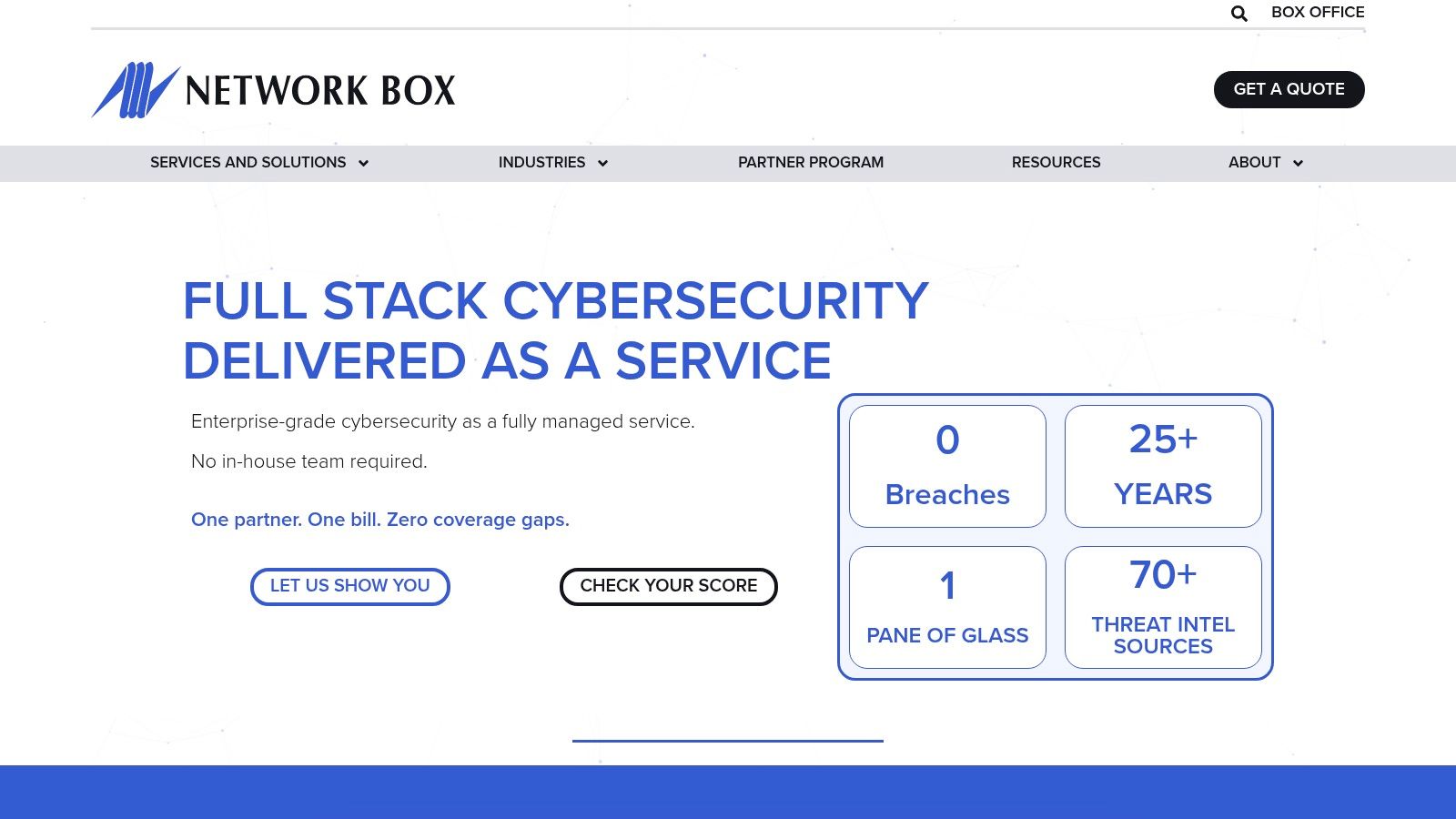
Network Box USA is a strong option when you want a broad MSSP stack from one Houston-based team. The company brings together MDR, EDR, XDR, UTM, web application firewall, secure web gateway, email security, dark web monitoring, SD-WAN security, and penetration testing. For a business tired of juggling point products, that kind of coverage can simplify procurement fast.
The selling point is not just the tool list. It is the way the service is packaged for SMBs and regulated industries. Network Box USA says it supports sectors like finance, healthcare, and education, which usually means the team is used to compliance-oriented conversations and more structured risk reviews. That can be a real advantage if your leadership wants one vendor who can talk about perimeter controls, endpoint detection, and testing without forcing you to assemble a Frankenstein stack from three different firms.
Where it works best
Network Box USA is a good fit for companies that want centralized security operations and clearly scoped testing. It can cover both day-to-day monitoring and periodic validation, which is often what SMBs miss when they only buy tools. Security tools do not prove they are working unless somebody checks them.
Security programs fail when nobody owns the gap between alerts and action.
The trade-off is scope. The website does not publish exact MDR pricing, so expect a discovery call and a custom quote. The stack is also fairly broad, which is great for a midsize office or a growing firm, but it may be more than a very small business needs if the core issue is just endpoint protection and basic monitoring.
For Houston buyers who want one vendor to handle perimeter security, threat monitoring, and testing, Network Box USA is a practical shortlist contender. If you want a lighter, repair-heavy, all-in-one IT partner instead, the comparison starts to favor a managed services shop like IT Cloud Global.
4. Netsync
Netsync is the right kind of choice when your security needs are tied to architecture, integration, and scale. It is a Houston-based systems integrator and managed services provider with a deep Cisco security practice, so it fits businesses that need security designed into the network instead of bolted on afterward.
The service mix is more technical than most SMB buyers expect. Netsync covers architecture, Zero Trust programs, identity and access, network and cloud security, DLP, compliance and governance, incident remediation, red teaming, and SIEM/SOAR implementations with Splunk. That is not a standard helpdesk package. It is the kind of portfolio a business calls on when it has multiple sites, a complex network, or a security program that needs to mature quickly.
Why technical buyers like it
Networksync's website signals a partner that can move from strategy to execution. That matters if you are dealing with leadership pressure to tighten controls without disrupting operations. A lot of firms can talk Zero Trust. Fewer can operationalize identity, logging, and remediation across a real environment.
The main strength is the depth of the Cisco ecosystem and the ability to support larger, more structured projects. The downside is the same thing. It is often project-led and integration-heavy, which means smaller businesses may find the process more involved than they want. If your need is packaged monitoring with simple monthly ownership, a pure MSSP may feel easier.
A useful way to think about Netsync is this, it suits buyers who care about design quality, not just coverage. If your internal team already knows what it wants to fix and needs an experienced integrator to implement it, Netsync can be a strong partner. If you want a simple, bundled service for endpoints, backup, and everyday support, it may be more than you need.
5. Truewater
Truewater is a strong fit for Houston SMBs that want managed IT and cybersecurity together without hiring separate providers for each. It has a long local presence, and that matters when your office, compliance needs, and staff problems are all happening at once.
The company's service mix includes 24/7 help desk, network monitoring, backup and disaster recovery, cloud management, firewall and endpoint management, and compliance assistance for HIPAA, SOX, and PCI. That makes it relevant for healthcare, legal, financial, and manufacturing organizations that need practical support, not just a security label on a sales deck.

What it does well
Truewater is a good example of the hybrid model that many Houston businesses buy. It is not only about tools. It is about keeping Microsoft 365, Azure, network monitoring, backups, and security policies aligned so one problem does not turn into three different tickets. For a small or midsize team, that simplification can be more valuable than flashy security branding.
The advantage is clear. One vendor, one contract, one support path. That reduces handoffs when something goes wrong and makes it easier to hold somebody accountable for both uptime and protection. The drawback is also clear. The website does not spell out in-house SOC depth or full MDR capabilities, so if you want advanced threat hunting or formal detection and response, you need to ask direct questions.
Practical rule: If your biggest pain is coordination, a hybrid MSP can be the right answer. If your biggest pain is active attack detection, go deeper on MDR capability.
Truewater is best for buyers who want stable support and security basics integrated into everyday IT operations. If you need pure-play incident response or a dedicated SOC, keep looking. If you want one local team to manage the stack and keep compliance conversations grounded, Truewater belongs on the list.
6. Cyber One Solutions
Cyber One Solutions is for buyers who want the structure of an MSP with the accountability of an MSSP. The company runs 24/7 NOC and SOC operations and sells a security-first baseline across its managed client base, which is the right idea for businesses that do not want to retrofit security after the fact.
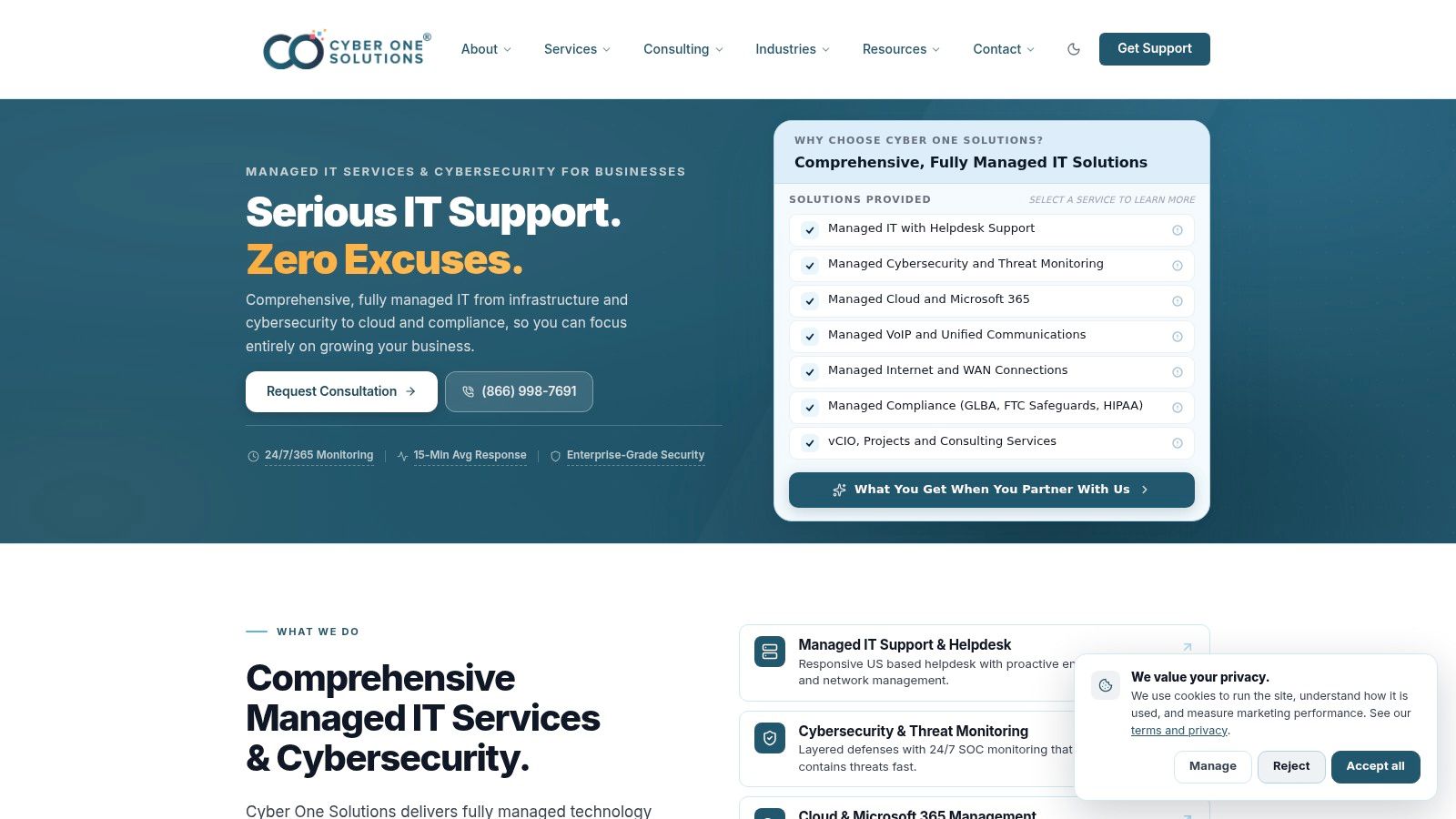
Its model is built around a standardized stack that includes EDR, MDR, MFA, privileged access controls, incident response, and immutable backups. That matters because the gap between “we have security tools” and “we can respond” is where many SMBs get burned. A provider that owns both helpdesk and security operations can reduce the finger-pointing that usually happens during an incident.
Why this hybrid model matters
Cyber One Solutions also has multiple Texas offices, including Houston, Dallas, Spring, and Lufkin, which can help when you need local on-site coverage. For businesses with a physical footprint and a need for fast response, that can be a real operational benefit.
The advantage is unified ownership. One team handles support and security, so fewer tickets get lost between departments. The downside is that tool specifics and compliance attestations are not spelled out publicly, so you'll need a scoping call to understand exactly what is included.
The company is a sensible choice if you want consistent controls across users and locations. It is less compelling if you want a very specialized security advisory team or a highly documented MDR program with published service detail. For many SMBs, though, the combination of NOC, SOC, and multiple offices is exactly what they need.
7. RD Sec
RD Sec makes sense for Houston businesses that need a vCISO plus hands-on security work. That combination is rare enough to matter. Many firms can advise. Fewer can advise, implement, and stay involved after the recommendations are made.
The company offers security assessments, architecture and design, ongoing managed security operations, 24/7 monitoring, incident response, and compliance guidance tied to regulated environments like ITAR and SOX. For a business that needs leadership help as much as technical help, that mix can be a better fit than buying tools alone.

Best use case for smaller security teams
RD Sec is a good option when the owner, CFO, or operations lead wants someone to translate security risk into business decisions. A vCISO can help set priorities, define controls, and stop random tool purchases from becoming a fake security program. That matters most for regulated or risk-sensitive SMBs that know they need structure but do not have a full-time security executive.
The strength here is the balance of advisory and execution. RD Sec does not stop at recommendations, which is where many consultants leave the work. The trade-off is that the tooling ecosystem and third-party attestations are not clearly published, so the discovery call matters a lot more than it would with a productized MSSP.
If your leadership team needs governance, architecture, and operational follow-through, RD Sec can be a strong fit. If you mainly want a managed helpdesk with security bolted on, a broader MSP may be easier to buy and run.
7 Houston Cybersecurity Companies Comparison
| Provider | Implementation Complexity 🔄 | Resource Requirements ⚡ | Expected Outcomes ⭐📊 | Ideal Use Cases 💡 | Key Advantages ⭐ |
|---|---|---|---|---|---|
| IT Cloud Global, LLC | 🔄 Moderate, combines managed services, on‑site repair and cloud work | ⚡ Moderate, dedicated engineers, 24/7 monitoring, in‑house repair depot | ⭐ Reliable day‑to‑day IT, fast device repair, improved security posture 📊 | 💡 Houston SMBs needing single provider for IT, repairs and cloud migrations | ⭐ End‑to‑end coverage + in‑house repair depot; strong security partnerships |
| Fortra's Alert Logic | 🔄 High, continuous SOC operations and tiered MDR delivery | ⚡ High, SOC staffing, data ingestion, licensing per tier | ⭐ Strong threat detection/hunting and compliance reporting 📊 | 💡 Organizations needing 24/7 MDR, AWS/O365 focus and compliance mapping | ⭐ Mature SOC/MDR leader with established threat hunting and reporting |
| Network Box USA | 🔄 High, broad perimeter and endpoint stack + testing services | ⚡ High, multiple security appliances, managed SOC, pen test resources | ⭐ Comprehensive perimeter protection and compliance testing outcomes 📊 | 💡 Regulated SMBs needing UTM/WAF/SWG + MDR and penetration testing | ⭐ One vendor for perimeter, SOC and testing; sector playbooks for SMBs |
| Netsync | 🔄 High, integration‑led projects and architecture work (Zero Trust) | ⚡ High, systems integrators, Cisco ecosystem, SIEM/SOAR deployments | ⭐ Enterprise‑grade security architecture and operationalized tooling 📊 | 💡 Multi‑site SMBs or orgs needing Cisco‑centric integrations and Splunk SIEM | ⭐ Deep Cisco security practice; SIEM/SOAR and offensive security expertise |
| Truewater | 🔄 Moderate, packaged MSP + security bundles and DR planning | ⚡ Moderate, 24/7 helpdesk, network monitoring, backup/DR capabilities | ⭐ Simplified IT/security management and local compliance support 📊 | 💡 Local Houston SMBs wanting single billing IT + security and compliance help | ⭐ 25+ years local experience; integrated IT and security service model |
| Cyber One Solutions | 🔄 Moderate‑High, combined MSP/MSSP with 24/7 NOC/SOC | ⚡ Moderate‑High, SOC/NOC staffing, standardized security stack, multiple offices | ⭐ Faster onsite response, standardized controls and incident readiness 📊 | 💡 Texas SMBs that need integrated IT/security and rapid on‑site support | ⭐ One contract for IT+security; multiple Texas offices for onsite coverage |
| RD Sec | 🔄 Moderate, advisory (vCISO) plus hands‑on implementation and ops | ⚡ Moderate, vCISO hours, architecture work, 24/7 monitoring for managed ops | ⭐ Aligned security leadership, mature programs and proactive monitoring 📊 | 💡 Regulated or risk‑sensitive SMBs that need vCISO and program build‑out | ⭐ Combines vCISO advisory with practical implementation and run‑state support |
Your Next Step Securing Your Houston Business
Choosing among the top cybersecurity companies in Houston comes down to fit, not hype. If you want one vendor to handle daily IT, cloud, repairs, and security, a hybrid MSP can make life simpler. If you need deeper monitoring, threat hunting, and incident response, a specialized MSSP or MDR provider is the better call. The Houston market is crowded, local risk is real, and the best partner is the one that matches how your business operates.
For many SMBs, the smartest move is to start with the basics. Get clarity on who owns endpoint protection, backups, Microsoft 365, cloud access, and incident response. Then decide whether you need a generalist with security depth or a specialist security operator with a narrower mission. Houston organizations that want fewer vendors and better day-to-day support will usually get the fastest path forward from a provider that can cover managed IT and cybersecurity together.
If you're ready to make the comparison real, start with an environment review and a free estimate. The right conversation will show you whether your business needs a full-service partner, a SOC-driven specialist, or a blend of both.
If you want a Houston provider that handles managed IT, cybersecurity, cloud support, and fast device repair in one place, IT Cloud Global, LLC is built for that job. Their team helps SMBs reduce vendor sprawl, tighten security, and keep daily operations moving without constant handoffs. Reach out, get a free estimate, and see whether their all-in-one model is the right fit for your business.
- 7 Top Cybersecurity Companies in Houston for 2026
- Top 7 Managed IT Services Houston TX Reviews 2026
- IT Security Services Houston TX: Essential for Your SMB In
- Best IT Services Houston TX: Your 2026 Partner
- Managed IT Services for Small Business Near Me: Houston
- Cloud Security Managed Service: The Ultimate 2026 Guide
- Data Breach Response Plan: Essential SMB Guide 2026