


Managed Network Services Houston: A 2026 Buyer’s Guide
A Tuesday morning outage in Houston rarely announces itself cleanly. Employees in an Energy Corridor office may lose access to a cloud accounting platform while the phones still work, or the wireless network may fail while wired desktops remain online. The office manager calls the internet provider, the owner calls an internal technician, and everyone debates whether the culprit is the firewall, a switch, a carrier handoff, or a bad cable in the server closet.
That confusion is what managed network services in Houston should eliminate. A capable provider takes responsibility for the network as an operating system for the business, not as a collection of devices that someone checks after they fail. The service should combine monitoring, maintenance, security, documentation, remote support, and local field response.
Houston is a substantial market for this model. The city has more than 150,000 businesses and a metro GDP above $530 billion, creating sustained demand for outsourced IT, network security, and support across industries. One market estimate says over 47% of Houston small and midsize businesses already use some form of managed IT services, compared with 31% five years earlier, a sign that buyers are moving away from ad hoc support toward recurring service relationships (Houston managed IT market overview).
Table of Contents
- What Managed Network Services Actually Do for a Houston Business
- The Core Building Blocks Inside a Managed Network Bundle
- How Day-to-Day Monitoring and Support Run in Practice
- Why Houston SMBs See Real ROI From Outsourcing the Network
- Choosing a Houston MSP on Local Response, Not Just 24/7 Promises
- Pricing Models Houston SMBs Encounter on MSP Quotes
- Your Next Step and a Short FAQ for Houston Buyers
What Managed Network Services Actually Do for a Houston Business
At 9:12 a.m., the tax filing deadline is approaching. Several employees at a professional services firm can't reach the cloud accounting system. The Wi-Fi symbol looks normal, but applications time out. Someone restarts a firewall. Another person swaps a network cable. Nobody knows whether the ISP circuit, a core switch, or an overloaded access point is responsible.
A managed network provider changes the response before that morning arrives. The provider inventories the environment, documents the traffic paths, monitors the equipment, maintains configurations, and establishes an escalation process. When an alert appears, an engineer investigates it instead of waiting for employees to describe symptoms during a crisis.
Ownership beyond the helpdesk
A helpdesk can reset a password. It usually can't make a failed switch pass traffic again without access to the network design, spare hardware, configuration backups, and a technician who can reach the building. Managed network services should cover the entire network layer, including firewalls, routers, switches, access points, wireless controllers, VPNs, and the physical connections that tie them together.
That ownership matters in Houston because offices, clinics, retail sites, warehouses, and multi-tenant buildings create different infrastructure problems. A warehouse may need careful access-point placement and durable cabling. A medical office may depend on reliable wireless access for staff devices and connected equipment. A high-rise office may require building access coordination before anyone can inspect a communications room.
The practical test: Ask whether the provider owns the incident from detection through recovery, including carrier escalation, hardware replacement, and onsite work.
Prevention is the real service
A strong MSP doesn't wait for a user to report every degraded link or failing component. Monitoring tools can flag unusual device behavior, capacity problems, failed interfaces, and offline equipment. Engineers then correlate the alert with configuration history, recent changes, carrier status, and physical conditions.
The value isn't a dashboard full of green icons. The value is fewer surprises, faster diagnosis, and a clear person accountable when the network fails. Houston buyers should judge providers by their ability to combine automation with local engineering, because remote monitoring alone won't repair a dead switch or trace a damaged fiber run.
The Core Building Blocks Inside a Managed Network Bundle
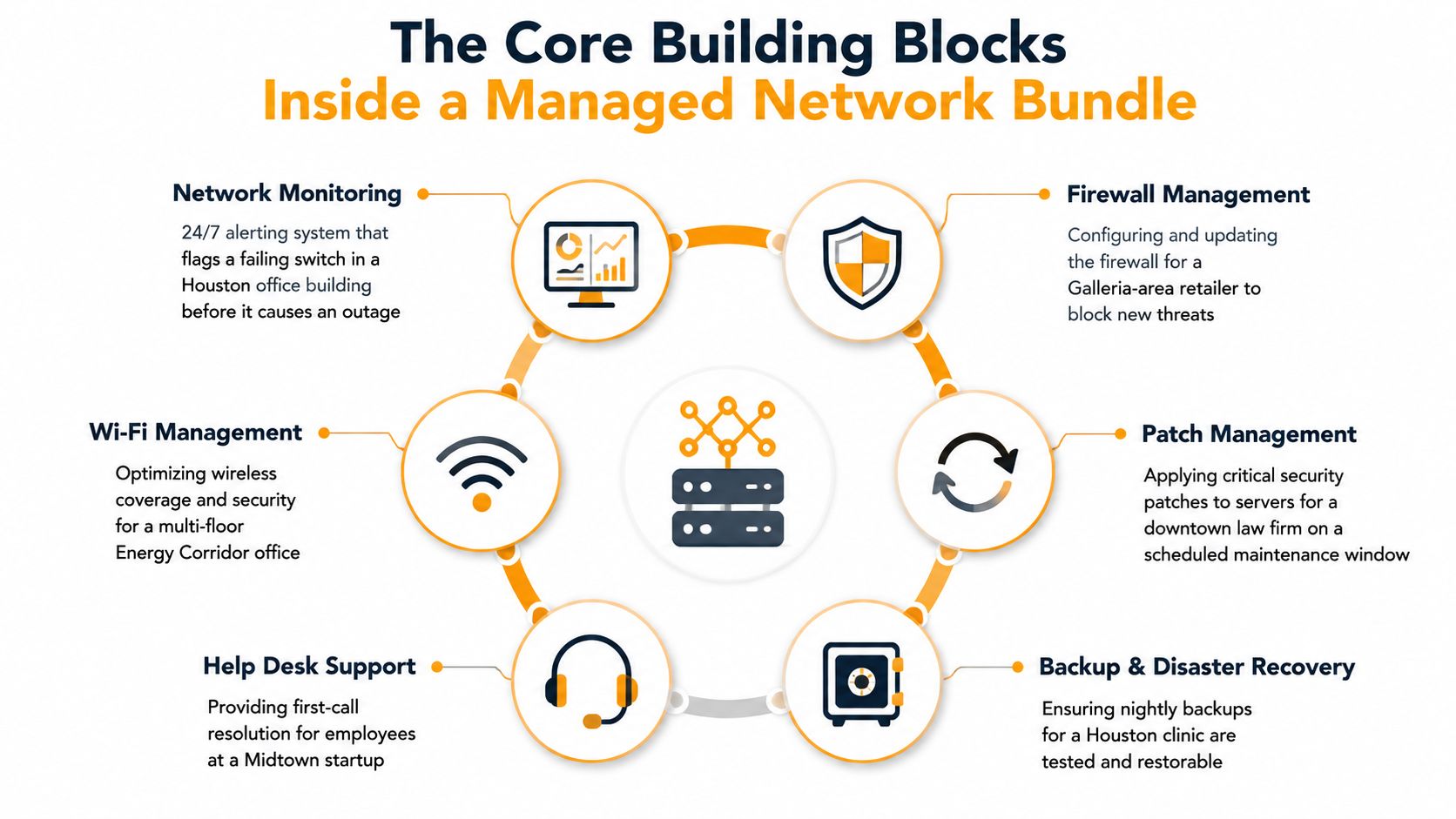
A Houston managed network agreement should assign clear ownership for monitoring, security, physical cabling, wireless design, and ongoing maintenance. Before signing, ask the MSP to explain how each component is delivered, what response it provides onsite, and which work remains outside the recurring fee.
Monitoring and device management
Network monitoring watches firewalls, switches, access points, circuits, and related infrastructure. In a Galleria office, an alert about a failing switch port should create a ticket before a full floor loses connectivity. The MSP should identify monitored devices, action thresholds, and after-hours alert handling.
WAN and LAN management covers routing and switching across one or multiple sites. It includes firewall policy maintenance, firmware planning, configuration backups, VLAN changes, VPN support, and carrier coordination. If a Sugar Land branch depends on a circuit connected to a Houston headquarters, the provider should document that dependency and manage it as part of the wider network.
Wireless and physical infrastructure
Wi-Fi design and management starts with a site survey. A clinic, warehouse, and multi-floor office have different coverage, interference, roaming, and capacity requirements. Wi-Fi 6 uses OFDMA and MU-MIMO scheduling to help more clients transmit efficiently in crowded environments. Intel's enterprise analysis found that, at 80 MHz, a full-featured Wi-Fi 6 network could support 25 users with about a 20% overall throughput degradation, a useful benchmark for dense SMB locations (Intel enterprise Wi-Fi 6 analysis).
Structured cabling includes certified Cat6 or Cat6a runs, organized patch panels, rack layout, and fiber between buildings or network rooms. Budget this work with the wireless redesign and security project. An access point connected through a damaged run, or an unlabeled patch panel, can turn a simple outage into a long onsite investigation.
Communications and cloud access
Managed VoIP and unified communications place phone quality under the same network team responsible for switching, wireless, and internet access. Engineers can then determine whether call problems come from jitter, congestion, wireless coverage, or the hosted phone platform.
Cloud connectivity may include SD-WAN, secure VPNs, or direct connections to Microsoft 365, Azure, AWS, or a regional data center. Ask whether the provider reviews bandwidth, traffic paths, failover behavior, and security controls. Cisco's Wi-Fi 6 design paper reports that a single Wi-Fi 6 stream on a 40 MHz channel can deliver up to a 43.5% raw throughput improvement over Wi-Fi 5, based on 287 Mbps versus 200 Mbps, reinforcing the need for channel planning and access-point placement (Cisco and Intel Wi-Fi 6 network design paper).
How Day-to-Day Monitoring and Support Run in Practice
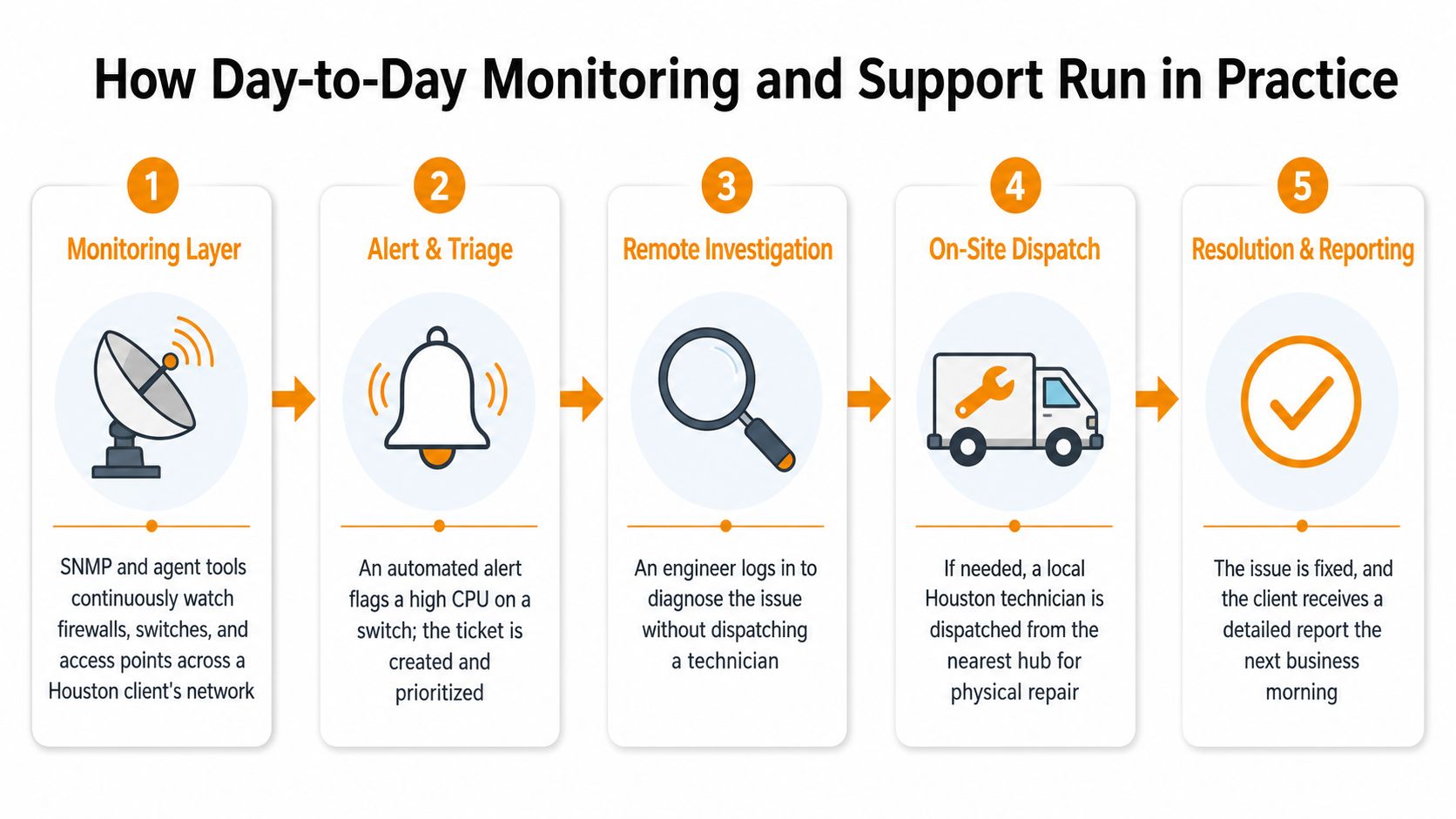
The difference between a real managed service and outsourced break-fix support appears in the daily workflow. A competent Houston MSP builds a repeatable chain from detection to triage, investigation, physical response, and reporting.
What happens before a user calls
SNMP and agent-based tools watch firewalls, switches, access points, servers, and circuits. The system can identify an unreachable device, high resource use, link errors, or a service that has stopped responding. The alert should create a ticket with context, not merely send an email into a neglected inbox.
The engineer then checks recent changes, device logs, configuration history, and related alerts. A switch with high resource use may need a configuration correction. A disconnected access point may require a remote reboot. A device that won't respond may need someone in the communications room.
How humans close the gap
Remote investigation comes first when it's safe and practical. Engineers can review the topology, test paths, validate firewall rules, and compare current behavior with documented baselines. If the problem is physical, dispatch coordination becomes part of the incident rather than a separate customer responsibility.
A local response plan should identify who contacts the carrier, who works with building management, who brings replacement equipment, and who communicates status to the client. Houston service areas can span downtown, the Energy Corridor, Katy, The Woodlands, Sugar Land, and industrial zones, so “local” needs a measurable definition.
For a useful explanation of how centralized operations support this workflow, review this network operations center overview.
Ask for visibility: Monthly reports should show incidents, root causes, recurring alerts, maintenance activity, open risks, and actions assigned to both the MSP and the client.
The best providers make the process visible through a shared dashboard and regular service reviews. They also track mean time to detect, mean time to resolve, recurring device failures, patch status, and unresolved recommendations. Documentation matters during audits, insurance reviews, employee turnover, and the next outage.
A managed network service should leave behind a usable record of what happened and why. If the provider can't explain the workflow, escalation rules, and reporting cadence, you're buying a promise rather than an operating service.
Why Houston SMBs See Real ROI From Outsourcing the Network
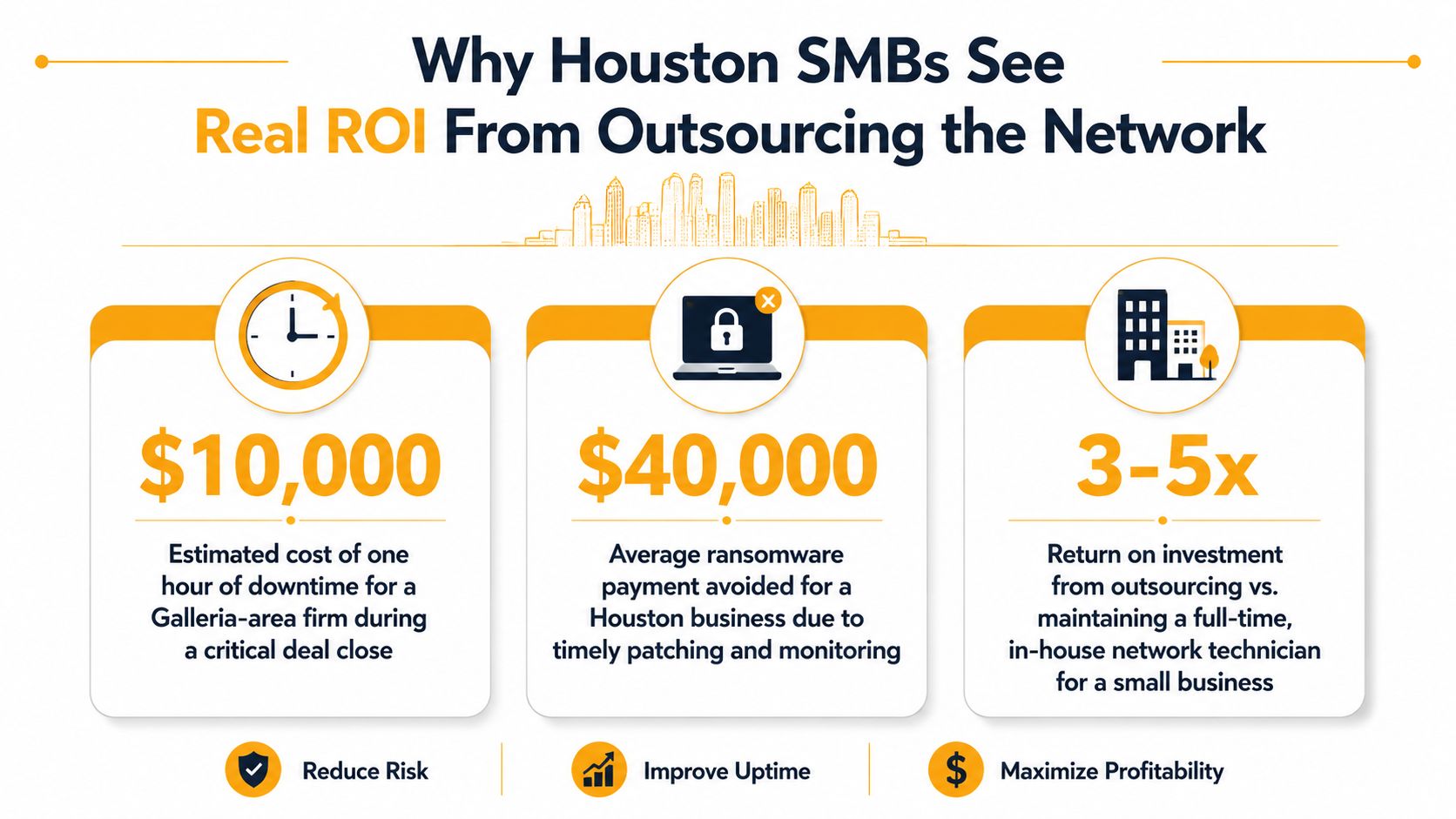
The financial case isn't limited to the monthly invoice. Owners feel network costs through missed calls, delayed transactions, idle employees, emergency hardware purchases, and security incidents that consume management attention.
A managed contract turns much of that uncertainty into a planned operating expense. The provider handles routine monitoring and maintenance, while the client can budget separately for projects such as a cabling refresh, a wireless redesign, or a firewall replacement. That separation is healthier than pretending every infrastructure need belongs inside a flat monthly fee.
The costs break-fix hides
Break-fix support looks inexpensive when the network behaves. The bill arrives only after something fails, which can make the model attractive to a small business watching cash flow. The weakness appears during a deadline, transaction, patient appointment, customer call, or multi-site outage, when the business also pays for lost productivity and delayed decisions.
Outsourcing can reduce the number of incidents that reach users by identifying failing equipment and configuration problems earlier. It can also shorten the path from diagnosis to repair when the MSP has documented the environment and maintains a local dispatch process.
Security and resilience belong in the ROI discussion
Network availability and security are connected. Verizon's 2026 DBIR data reports that ransomware was involved in 48% of breaches, vulnerability exploitation rose 55% as an initial access vector, third-party breaches grew 60%, and 96% of ransomware victims were SMBs (Houston managed network infrastructure discussion). Those figures make patching, access control, backup validation, and vendor accountability business issues, not just technical preferences.
The broader market is moving in the same direction. Managed network services were estimated at $66.24 billion in 2024, rising to $69.68 billion in 2025 and projected to reach $115.83 billion by 2034, representing a 5.8% CAGR. The same market research estimated that the United States generated around $19.49 billion in 2024 and represented about 89% of North American revenue (managed IT services market context for Houston).
My recommendation: Don't compare managed services with the cost of the last repair. Compare them with the operational exposure of the next unresolved failure.
Better wireless design can reduce employee frustration and improve application access. Reliable VoIP protects customer communication. Cloud connectivity reviews can expose weak failover paths and poorly planned traffic flows. Those gains compound, but only when the contract covers engineering work rather than dashboard access alone. A detailed ROI framework for local buyers is available in this Houston managed IT services ROI guide.
Choosing a Houston MSP on Local Response, Not Just 24/7 Promises
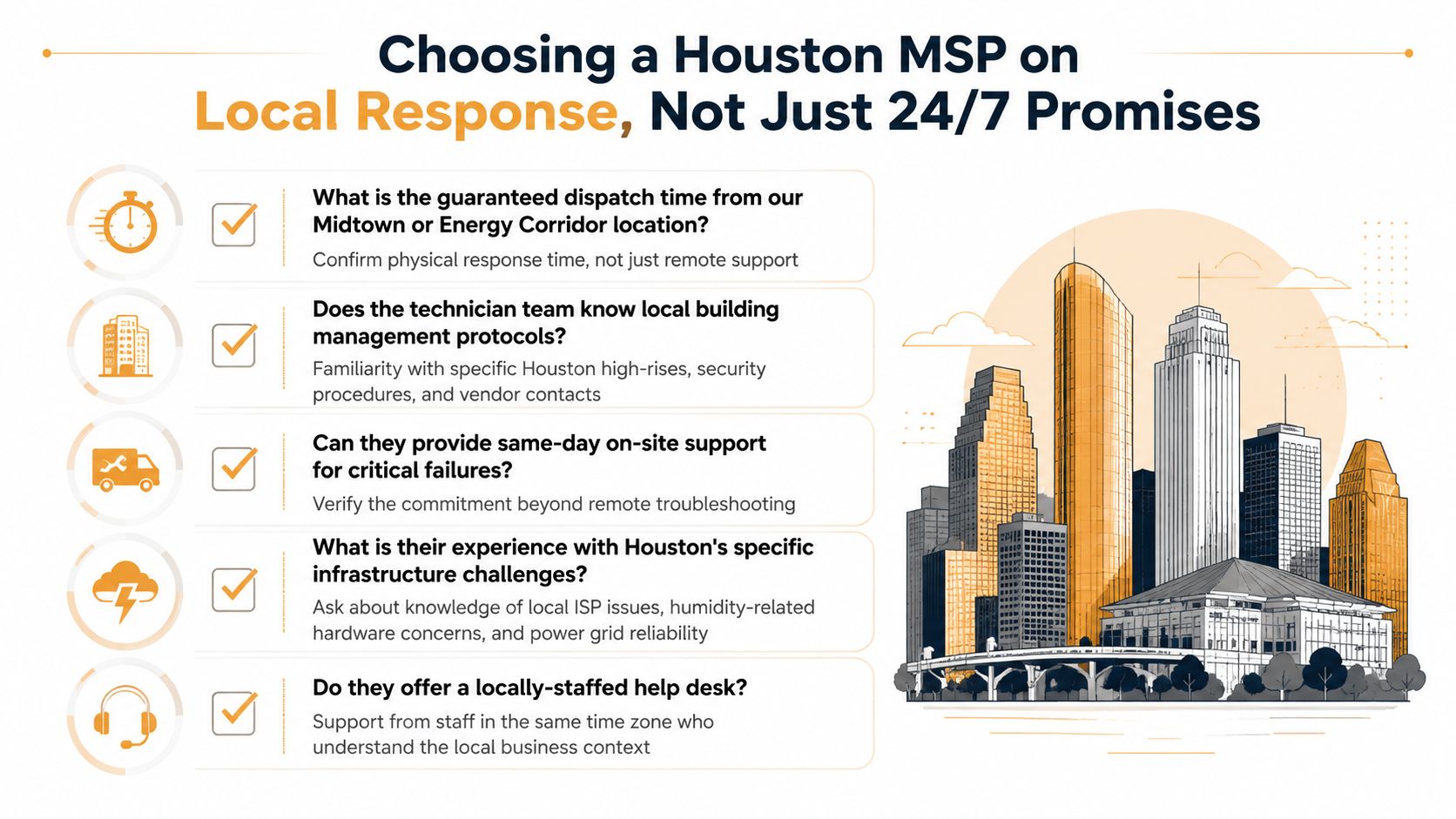
“24/7 support” is not a response plan. It may mean a technician is watching alerts overnight, a call center is taking messages, or an engineer can begin remote troubleshooting. None of those statements proves someone will enter your building when a switch dies or a fiber run fails.
The buying question is simple: who takes physical responsibility when remote support can't restore service?
Questions that expose the real service
Ask these questions in writing, and require answers tied to your location:
- Where are your engineers based? Get the actual service area, not a generic Houston label.
- What is the guaranteed onsite response time by ZIP code? Ask specifically about Midtown, the Energy Corridor, the suburbs, and any satellite offices.
- Who contacts the carrier when the circuit fails? The MSP should own escalation with providers such as AT&T, Comcast Business, or Lumen instead of telling your office manager to open a ticket.
- Can you show recent mean-time-to-resolve reporting? Review the format and the definitions, not just a marketing average.
- What does the SLA exclude? Identify after-hours labor, hardware replacement, cabling, project work, building access delays, and carrier outages.
- What happens during a hurricane or regional disruption? A provider should explain staffing, dispatch prioritization, communications, and backup procedures.
A local engineer also needs to understand building rules. High-rise properties may require loading-dock reservations, security clearance, escorted access, or coordination with building engineers. Industrial sites may have long travel paths between network rooms and production areas. Those details affect recovery time even when the MSP's remote tools work perfectly.
Red flags Houston buyers should reject
An out-of-state network operations center with no field team can monitor devices, but it can't provide local recovery by itself. A one-engineer shop may offer personal service until that engineer is unavailable, overloaded, or dealing with the same regional disruption as your business.
The provider should explain its escalation bench, replacement hardware process, vendor relationships, and documentation standards. It should also distinguish a critical emergency from a next-business-day request, because vague priority language creates conflict during an outage.
Local response is the hidden variable in the price. A cheaper contract can become expensive if it leaves your team coordinating carriers, building access, and physical repairs.
Use this managed service provider selection guide to structure the comparison. Then ask each finalist to walk through the same outage scenario, including detection, communication, dispatch, repair, and post-incident reporting.
Pricing Models Houston SMBs Encounter on MSP Quotes
Houston MSP quotes usually use four pricing structures. None works for every business. Match the contract to how your company adds users, opens locations, depends on network infrastructure, and approves project work.
| Model | What It Covers | Best Fit | Where It Fails |
|---|---|---|---|
| Per-device | Monitoring and support for defined network or endpoint devices | A small office with a stable device inventory | Growth adds billable devices, while switches, firewalls, and cabling may sit outside scope |
| Per-user | Service aligned with employees and their support needs | Professional services firms where headcount drives demand | Quotes may exclude network equipment, physical work, and infrastructure projects |
| All-inclusive flat rate | A predictable recurring fee for an agreed service scope | Owners who want simpler budgeting and one accountable provider | Exclusions can make after-hours onsite work, hardware, and projects unexpectedly expensive |
| Co-managed | The MSP supplies monitoring, specialist skills, after-hours coverage, or projects while internal IT retains control | Businesses with an internal IT lead that needs more depth | Responsibilities can become unclear if ownership and escalation aren't documented |
Read the exclusions before the headline price
Per-device pricing looks attractive in a small environment, but expansion can add a separate charge for every laptop, printer, access point, and firewall. Per-user pricing follows staffing more naturally. The network still requires maintenance when headcount stays flat.
Flat-rate pricing helps finance plan recurring costs, provided “all-inclusive” work is itemized. Ask whether the agreement covers firmware maintenance, firewall changes, onsite troubleshooting, carrier coordination, replacement installation, wireless adjustments, and after-hours emergencies. In Houston buildings, cabling faults, poor access-point placement, and damaged equipment can create project costs that a monitoring plan does not cover.
Separate operations from projects
For a Houston SMB with a moderate user base, a practical quote often combines recurring monitoring and support with separate project lines for cabling, Wi-Fi redesign, major hardware, site moves, and new-office deployment. Separating operations from projects is transparent and aligns incentives. It prevents capital work from being buried in monthly fees and then abandoned during execution.
That split also makes local response easier to price. Your recurring service should state how monitoring, remote remediation, and escalation work. Project pricing should identify the labor, hardware, building access, and carrier coordination required to repair or redesign the physical network.
Co-managed service deserves close review when an internal IT manager understands the business but lacks overnight coverage or specialized network expertise. The MSP can monitor the environment, handle escalations, manage complex changes, and provide field support without replacing the internal team. Document ownership before signing, especially for firewall changes, wireless design, vendor calls, and emergency dispatch.
Before comparing totals, normalize the proposals. Put the same sites, devices, service hours, response targets, project assumptions, and exclusions into a side-by-side sheet. The lowest monthly number means little if it excludes the physical work your Houston buildings already need.
Your Next Step and a Short FAQ for Houston Buyers
Don't start by requesting generic proposals. Start with evidence from your own environment.
This week, pull the last three months of network incidents, list every office and ISP, identify the firewalls and switches at each site, and note recurring Wi-Fi or phone complaints. Then invite two Houston-area MSPs to perform an onsite walkthrough. Ask each provider for a written scope, a response-time SLA tied to your service areas, a list of exclusions, and an explanation of how cabling, Wi-Fi design, security, and carrier escalation fit together.
If your physical infrastructure needs a deeper review, a specialized telecom infrastructure partner can help evaluate cabling and connectivity requirements alongside the MSP.
Questions Houston buyers ask
Does a managed bundle replace break-fix support?
It should replace reactive support as the primary operating model, but it doesn't eliminate project work or hardware replacement. The contract should explain what the MSP monitors, maintains, repairs, and escalates, along with what receives separate project pricing.
How does onsite response work in The Woodlands or Sugar Land?
Ask for a location-specific commitment. “Houston metro” can cover a wide area, so the provider should state dispatch targets, after-hours procedures, travel assumptions, and the process for coordinating access to your building.
What contract length should we expect?
The right term depends on the equipment, transition effort, and service scope. Focus less on a universal term and more on onboarding responsibilities, termination language, renewal rules, price changes, and the handoff process if the relationship ends.
Can VoIP and cabling be included?
Yes, they can be managed under one relationship, but the quote should distinguish recurring administration from installation, replacement, re-termination, and new cabling. Combining accountability is useful, as long as the scope remains visible.
How does pricing change when we add offices?
The provider should explain how new users, devices, circuits, access points, firewalls, and onsite coverage affect the recurring fee. Require a documented process for adding a site so expansion doesn't trigger an unexpected pricing dispute.
What security reporting should arrive each month?
Request patch status, firewall and endpoint alerts, backup outcomes, unresolved risks, incident summaries, configuration changes, and recommended actions. Reporting should help management decide what to fund next, not just prove that a dashboard exists.
IT Cloud Global, LLC is one Houston option for businesses that need coordinated managed IT, network security, onsite and remote support, cabling, Wi-Fi work, cloud administration, and disaster recovery. The right next move is a network assessment that connects your incident history to the physical condition of each site and the response capability written into the contract.
IT Cloud Global, LLC provides Houston businesses with proactive monitoring, helpdesk and onsite support, network security, Wi-Fi and low-voltage cabling, cloud administration, and disaster recovery services. Visit IT Cloud Global, LLC to request a practical network assessment and discuss a support plan built around your sites, infrastructure, and response needs.
- Outsource IT Service Houston: 2026 MSP Vetting Guide
- 7 Top Cybersecurity Companies in Houston for 2026
- Top 7 Cybersecurity Companies in Houston for 2026
- What Is Network Redundancy and Why Your Business Needs It
- Top 7 Managed IT Services Houston TX Reviews 2026
- Managed IT Services for Small Business Near Me: Houston
- Managed IT Solutions: Grow Your Houston Business