


IT Security Assessment: A Practical Guide for Houston SMBs
A Houston business can have antivirus on every laptop, a firewall at the office, and Microsoft 365 running in the cloud, yet still have no reliable answer to a basic question: Could the company keep operating after a serious breach? That answer usually becomes urgent after a convincing phishing email, a vendor incident, an insurance renewal request, or ransomware hits a business down the road.
An IT security assessment is the practical way to find those gaps before an attacker, auditor, insurer, or major customer finds them for you. It isn't a hunt for scary screenshots. Done properly, it connects technical weaknesses to business decisions, budget priorities, recovery capability, and the risks Houston SMBs face every day.
Table of Contents
- When a Houston SMB Realizes It Needs an IT Security Assessment
- What an IT Security Assessment Actually Covers
- Main Assessment Types and When Each One Makes Sense
- How an Assessment Actually Runs From Start to Finish
- Deliverables, Costs, and How to Think About ROI
- Mapping Assessment Results to Compliance Frameworks
- What to Expect From an MSP Like IT Cloud Global
- Your 30 60 90 Day Next Steps and Common SMB Questions
When a Houston SMB Realizes It Needs an IT Security Assessment
A Houston construction company once felt reasonably protected because its laptops had antivirus, the office had a firewall, and Microsoft 365 handled email. The owner changed his mind after an employee nearly entered credentials into a fake Microsoft login page. The near miss exposed a larger problem: no one had reviewed dormant accounts, third-party application access, mailbox forwarding rules, backup recovery, or who could approve payments.
Nothing had been breached yet. The company still had a security problem.
That moment often arrives through one of four doors:
- A near-miss phishing message: Someone clicks a link, reports it late, or sends credentials to an attacker. The event exposes weaknesses in training, multifactor authentication, email protection, and reporting procedures.
- A vendor incident: A payroll provider, accounting firm, software platform, or outsourced IT partner suffers an incident. Management then asks what data the vendor can access and whether the business could revoke that access quickly.
- An insurance renewal: The carrier asks for evidence of MFA, backups, endpoint protection, incident response, and privileged access controls. “Our IT company handles it” isn't evidence.
- A peer company gets hit: Ransomware at a competitor turns cybersecurity from an abstract concern into an operational threat. Owners start asking how long payroll, scheduling, quoting, and customer communications could continue offline.
The assessment works like a medical diagnostic. A doctor doesn't wait for a patient to reach the emergency room before checking blood pressure, risk factors, and symptoms. A security advisor should review the environment before a crisis forces rushed decisions.
The blind spots that matter
The biggest weaknesses aren't always visible in a vulnerability scanner. A business may have strong endpoint software but weak identity governance. It may have backups that run successfully but have never been restored. It may use Microsoft 365 every day without reviewing risky app permissions, administrator roles, conditional access, or data sharing.
Houston SMBs also face practical continuity concerns. Storms, power interruptions, office moves, remote work, contractor access, and dependence on cloud platforms can all affect recovery. The assessment should identify which systems the business needs first, who can make decisions during an incident, and whether the organization can operate while a provider or platform is unavailable.
The right question isn't, “Do we have security tools?” It is, “Can we produce evidence that our controls work, and can our people use them under pressure?”
What an IT Security Assessment Actually Covers
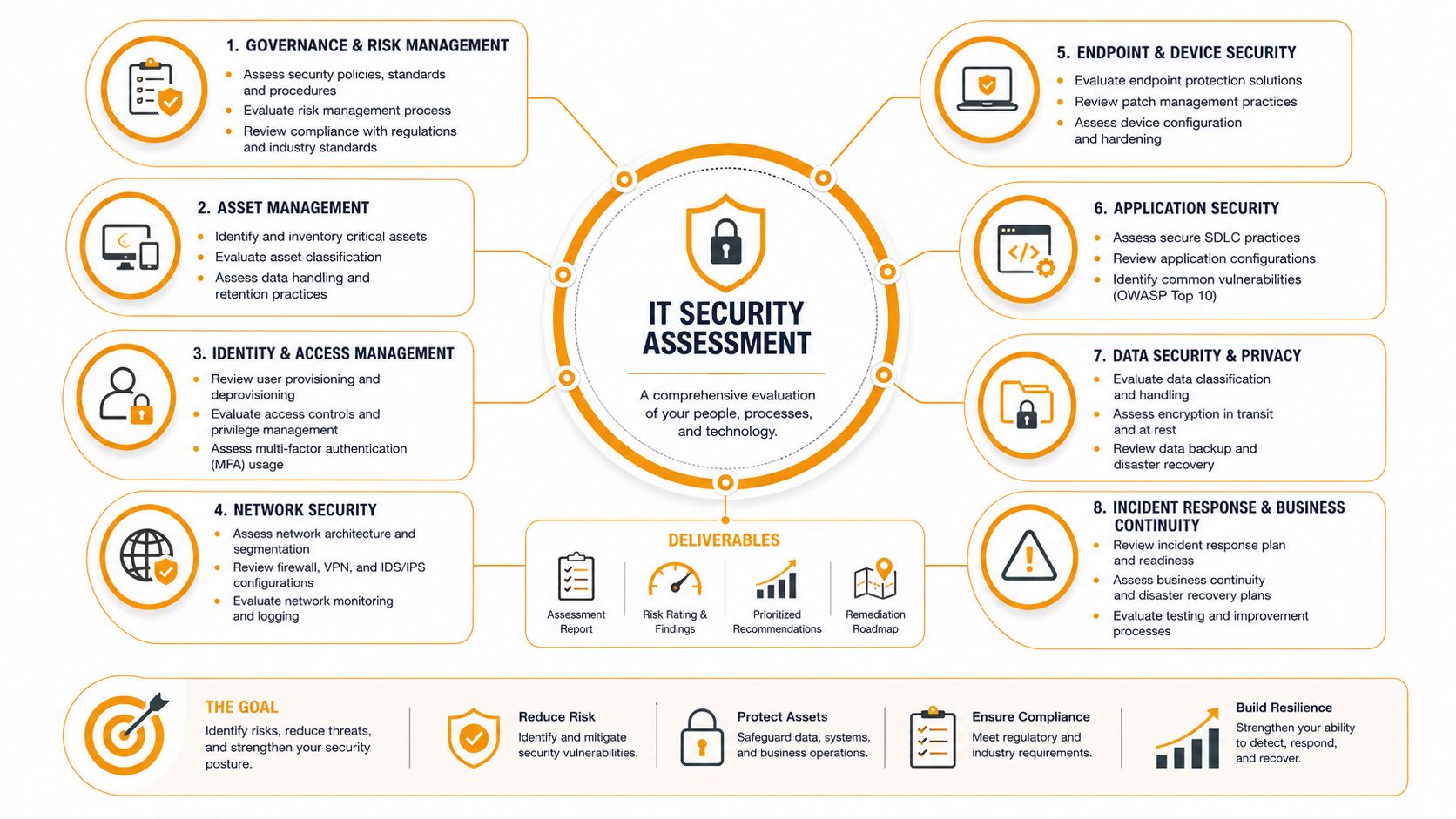
An IT security assessment is a structured review of how well an organization's people, processes, and technology protect information and keep operations available. It combines interviews, documentation review, configuration analysis, technical testing, and evidence collection.
NIST's formal testing guidance began with Special Publication 800-115, published in September 2008, and NIST later updated its measurement guidance through SP 800-55 Rev. 2 in 2024. That progression reflects a move from isolated technical checks toward continuous measurement, risk management, performance goals, and flexible metrics across frameworks such as the Cybersecurity Framework. NIST's information security testing guidance supports the practical conclusion that an assessment should measure control effectiveness, not merely list vulnerabilities.
The technology review
A serious review examines the systems that store, process, transmit, and protect business information:
- Identity and access: User accounts, administrator roles, MFA, dormant users, service accounts, privileged access, and joiner-mover-leaver procedures.
- Endpoints: Laptops, desktops, mobile devices, patching, encryption, endpoint detection, local administrator rights, and remote management.
- Network: Firewalls, wireless networks, segmentation, remote access, exposed services, device inventories, and monitoring.
- Cloud and SaaS: Microsoft 365, Azure, AWS, Google Workspace, SharePoint, Teams, backup configuration, external sharing, application consent, and tenant administration.
- Applications and vendors: Business-critical software, integrations, data access, contract responsibilities, support accounts, and exit options.
- Backups and recovery: Backup coverage, retention, isolation, recovery priorities, and evidence from restoration tests.
A review may include automated vulnerability scanning services when the scope calls for them. Scanning is useful, but it can't determine whether a finance system is more important than a low-value workstation or whether an employee knows how to report a suspected compromise.
The people and process review
Interview staff who approve payments, manage users, handle customer data, and respond to technology problems. Ask how incidents are reported, who contacts the bank, who can disable accounts, how vendors are notified, and what happens if Microsoft 365 is unavailable.
Review written policies, risk ownership, security awareness, incident response, business continuity, change management, and vendor oversight. Organizations interested in a broader regional perspective can also consult Wisenet Security Ltd.’s resource on cyber security for South Wales, which offers useful context for evaluating security beyond tools alone.
Practical rule: A scan identifies technical conditions. An assessment produces evidence that helps leaders decide what to fix, fund, accept, or test again.
The final output should support budgets, compliance readiness, insurance conversations, and operational resilience. If a provider gives you raw scanner output and calls the job complete, you bought a scan, not an assessment.
Main Assessment Types and When Each One Makes Sense
SMBs often use “assessment” to describe several different services. They aren't interchangeable, and buying the wrong one wastes money.
| Assessment type | Best trigger | Typical deliverable |
|---|---|---|
| Vulnerability scan | Routine technical hygiene or a known exposure | Prioritized technical findings |
| Penetration test | Need to validate defensive barriers or satisfy a customer request | Attack-path report with evidence |
| Risk assessment | Leadership needs business-prioritized decisions | Risk register and treatment roadmap |
| Compliance audit | HIPAA, PCI-DSS, CMMC, or customer requirement | Control evidence and gap report |
| Cloud security review | Azure, Microsoft 365, AWS, or Google Workspace change | Configuration and identity findings |
Vulnerability scans
A vulnerability scan uses automated tools to identify known weaknesses, missing patches, unsafe configurations, and exposed services. It works well as recurring hygiene, especially after major infrastructure changes. The output is technical and should be reviewed by someone who can separate an exploitable business risk from a low-priority informational finding.
Penetration tests
A penetration test goes further by attempting controlled exploitation. Testers examine whether they can move from an entry point to sensitive systems, escalate privileges, access data, or bypass controls. Use one when a customer, insurer, board, or regulated process needs evidence that defenses were tested, or when you need to validate a specific high-risk scenario.
Don't start with a pen test because it sounds more serious. If nobody knows the asset inventory, account ownership, or business priorities, the test may produce impressive findings without a workable remediation plan.
Risk assessments
A risk assessment connects threats and weaknesses to business impact. It asks what could interrupt operations, expose sensitive information, create contractual problems, or damage trust. This is usually the right starting point for an SMB that needs a security budget, a board-ready risk register, or a defensible plan.
NIST describes the assessment as a structured, repeatable process that feeds the broader Risk Management Framework. NIST SP 800-30 Rev. 1 emphasizes that weak scope definition and incomplete asset information degrade threat identification and risk prioritization.
Compliance audits
A compliance audit tests whether required controls exist and whether the organization can prove they operate. HIPAA, PCI-DSS, and CMMC each create different evidence demands. Compliance shouldn't replace risk analysis, but it can provide a clear boundary when a customer, contract, or regulator sets the requirement.
Cloud security reviews
A cloud review focuses on identity, administrative roles, application permissions, sharing, logging, data protection, recovery, and configuration. It makes particular sense during a Microsoft 365 or Azure migration, after a merger, or when a company relies heavily on cloud SaaS without a clear ownership model.
For website owners, a focused resource on building a repeatable WordPress audit process can help separate application-specific checks from an organization-wide assessment.
If this is your first project, begin with a risk and control review. Add scanning, cloud testing, or penetration testing after the scope and priorities are clear.
How an Assessment Actually Runs From Start to Finish
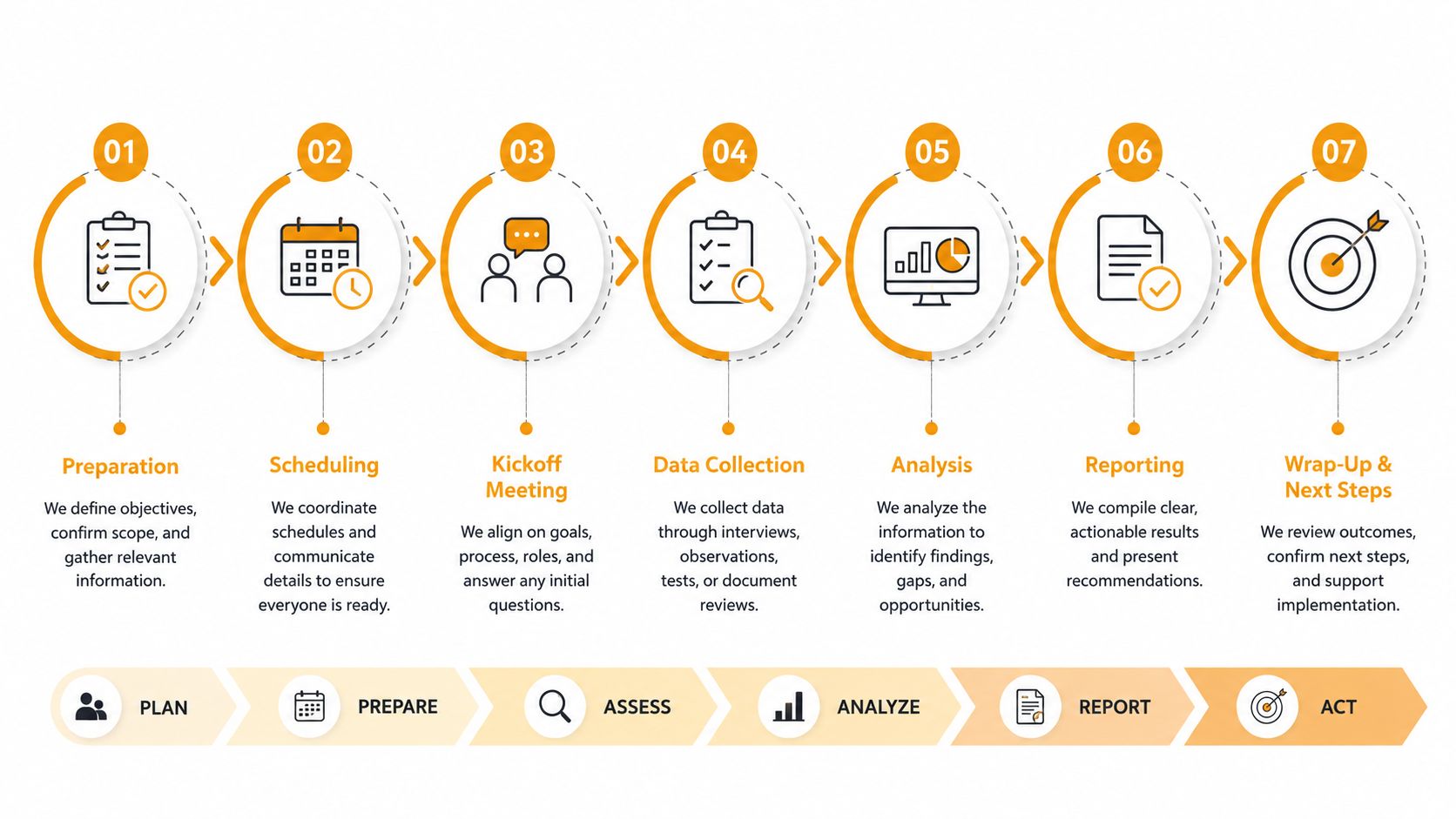
A well-run assessment follows a sequence. The sequence matters because technical testing performed against an incomplete scope creates false confidence.
For a Houston company with 25 to 75 employees, a practical engagement may take four to eight weeks from kickoff to final roadmap. The exact schedule depends on locations, cloud complexity, documentation quality, and staff availability.
Scope and inventory
The first week should establish objectives, systems, locations, data types, vendors, exclusions, and contacts. Build an inventory covering endpoints, network devices, cloud tenants, applications, administrator accounts, backups, and third-party connections.
This work looks administrative, but it determines what the assessor can see. If a forgotten SaaS platform, remote office, or privileged account stays outside scope, the final risk picture is incomplete.
Interviews and evidence collection
Interviews and questionnaires commonly occupy one to two weeks. Speak with leadership, finance, operations, HR, IT, and employees who handle sensitive information. Collect policies, network diagrams, backup records, access reviews, incident procedures, insurance questionnaires, and vendor documentation.
Ask people what they do, not what the policy says they should do. A written incident plan that nobody has practiced is a document, not readiness.
Technical and cloud testing
Technical scans and configuration reviews may take one to three weeks, depending on the environment. Review endpoints, firewalls, wireless networks, identity platforms, Microsoft 365, Azure, AWS, Google Workspace, applications, and backup systems.
Testing should include identity and cloud controls, not only internal network devices. Microsoft 365 dependency creates a particular risk when a business assumes the platform provider manages every security decision. Tenant configuration, permissions, recovery, and administrative governance remain the customer's responsibility.
Analysis, reporting, and retesting
Report drafting typically takes one to two weeks. The assessor should rank findings by business impact, likelihood, exploitability, control weakness, ownership, and remediation effort. The report must distinguish urgent exposure from work that can be scheduled.
Use the IT risk assessment service as a reference point when comparing provider scopes and deliverables. The key is not the branding. It is whether the provider delivers a usable risk register and remediation plan.
After fixes, retest the important findings. A closed ticket isn't proof that a control works. The retest should confirm the configuration, access path, recovery procedure, or policy change addressed the original risk.
Deliverables, Costs, and How to Think About ROI
A security assessment should leave the owner with decisions, not a large PDF that nobody reads.
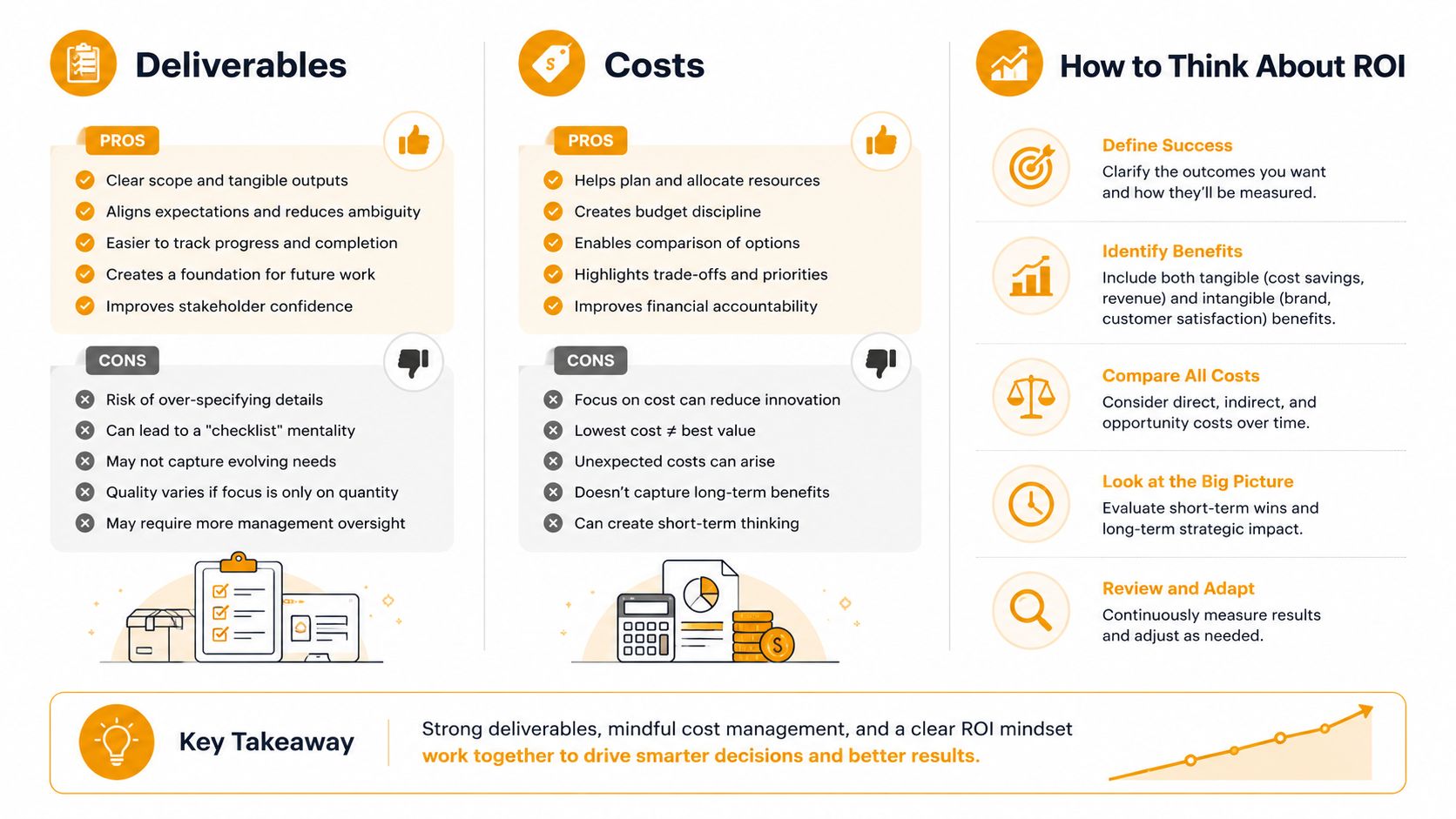
A useful deliverable includes:
- Executive summary: The most important business risks, written for leadership rather than engineers.
- Risk-ranked findings: Each finding linked to affected assets, business consequences, evidence, and recommended action.
- Remediation roadmap: Owners, dependencies, sequencing, effort categories, and a realistic target schedule.
- Evidence pack: Policies, screenshots, test records, access reviews, backup evidence, and other material useful for insurers or auditors.
- Retest plan: A clear method for confirming that significant findings were resolved.
A poor deliverable reverses that order. It leads with scanner output, labels everything critical, offers generic recommendations such as “improve security,” and leaves the internal team to guess what to do next.
Budgeting without fake precision
Houston SMB assessment pricing varies with scope. A basic external vulnerability review costs less than a multi-site assessment covering Microsoft 365, Azure, endpoints, vendors, interviews, policy analysis, penetration testing, and retesting. Ask providers to separate discovery, testing, reporting, remediation support, and follow-up validation.
Don't compare proposals by hourly rate alone. Compare what each provider will inspect, what evidence you'll receive, whether cloud and identity are included, and whether remediation assistance is part of the engagement.
The business case
ROI comes from reducing avoidable disruption and improving decisions:
- Ransomware exposure: Better identity controls, segmentation, backups, and recovery procedures can reduce the chance that one compromised account becomes a company-wide outage.
- Insurance evidence: A documented assessment can show that the business understands its controls and is addressing known gaps. It can't guarantee lower premiums, but it can improve the quality of the underwriting conversation.
- Operational continuity: A recovery plan helps leadership prioritize payroll, customer communication, scheduling, finance, and core production systems during an outage.
The global security assessment market was estimated at USD 8.5 billion in 2024 and projected to reach USD 15.5 billion by 2030, with a 10.3% CAGR in that forecast. Strategic Market Research's security assessment market estimate illustrates that assessments have become a recurring management activity, not a niche technical purchase.
Mapping Assessment Results to Compliance Frameworks
Most Houston SMBs don't want five separate security projects. They want one accurate assessment whose evidence can be mapped when a customer, insurer, auditor, or contract asks for a particular framework.
A strong assessment can organize findings against the NIST Cybersecurity Framework, ISO 27001, HIPAA, PCI-DSS, and CMMC. The same evidence may support multiple requests, although each framework still has its own scope and validation requirements.
Principle-based frameworks
NIST CSF and ISO 27001 give organizations a structured way to manage risk and improve controls. They focus on outcomes, governance, risk ownership, and repeatability rather than only checking isolated technical settings.
ISO 27001 requires a documented and repeatable method for identifying, analyzing, and evaluating information-security risks. Many organizations use a 5×5 likelihood-and-impact matrix to rank residual risk across assets and business units. This ISO 27001 risk assessment guide explains the practical value of documenting the method, evaluation result, owner, and treatment decision.
That structure lets leadership prioritize a high-impact issue on a critical system over a larger number of low-exposure findings. It also makes risk acceptance visible instead of allowing unresolved issues to disappear into a spreadsheet.
Prescriptive frameworks
HIPAA and PCI-DSS provide more specific control expectations. A healthcare organization must connect safeguards to protected health information, while a payment environment must define and protect the cardholder data environment. CMMC adds requirements relevant to organizations handling controlled information under defense contracting obligations.
The assessment should tag findings by affected system, data type, control objective, evidence status, and responsible owner. A missing MFA control may map to several frameworks, while a payment-system segmentation issue may apply specifically to PCI scope.
For cloud-focused organizations, cloud security compliance services can provide a useful comparison point when evaluating how providers document cloud controls and compliance evidence.
The practical objective isn't to claim that an SMB is “doing ISO.” It is to maintain a reusable evidence base so the business can answer new compliance questions without starting from zero.
What to Expect From an MSP Like IT Cloud Global
An MSP running an assessment should begin with a scoping call, not a sales pitch for a scanner. Expect an asset and identity inventory, questionnaires, employee and leadership interviews, technical testing, cloud configuration review, findings analysis, and a remediation handoff that turns recommendations into ticket-level work.
The cloud review should cover the platforms the business uses, such as Microsoft 365, Azure, AWS, or Google Workspace. It should also examine vendor access, privileged roles, application permissions, backups, logging, and recovery responsibilities. A provider that ignores SaaS governance is missing a major part of the modern attack surface.
IT Cloud Global, LLC operates from Houston and provides managed IT services, dedicated engineering support, 24/7 support, cloud administration, network security, disaster recovery, and regular security assessments and penetration testing. Its vendor relationships, including SentinelOne, Arista Networks, Atakama, and Ultatel, can align with findings involving endpoint protection, network architecture, file-level encryption, and communications.
Use that as a buying checklist, not a reason to skip due diligence. Ask every MSP who owns the findings, how remediation is tracked, what happens after the report, and whether the provider will retest fixes. The right partner should help you move from evidence to action without burying the owner in technical language.
Your 30 60 90 Day Next Steps and Common SMB Questions
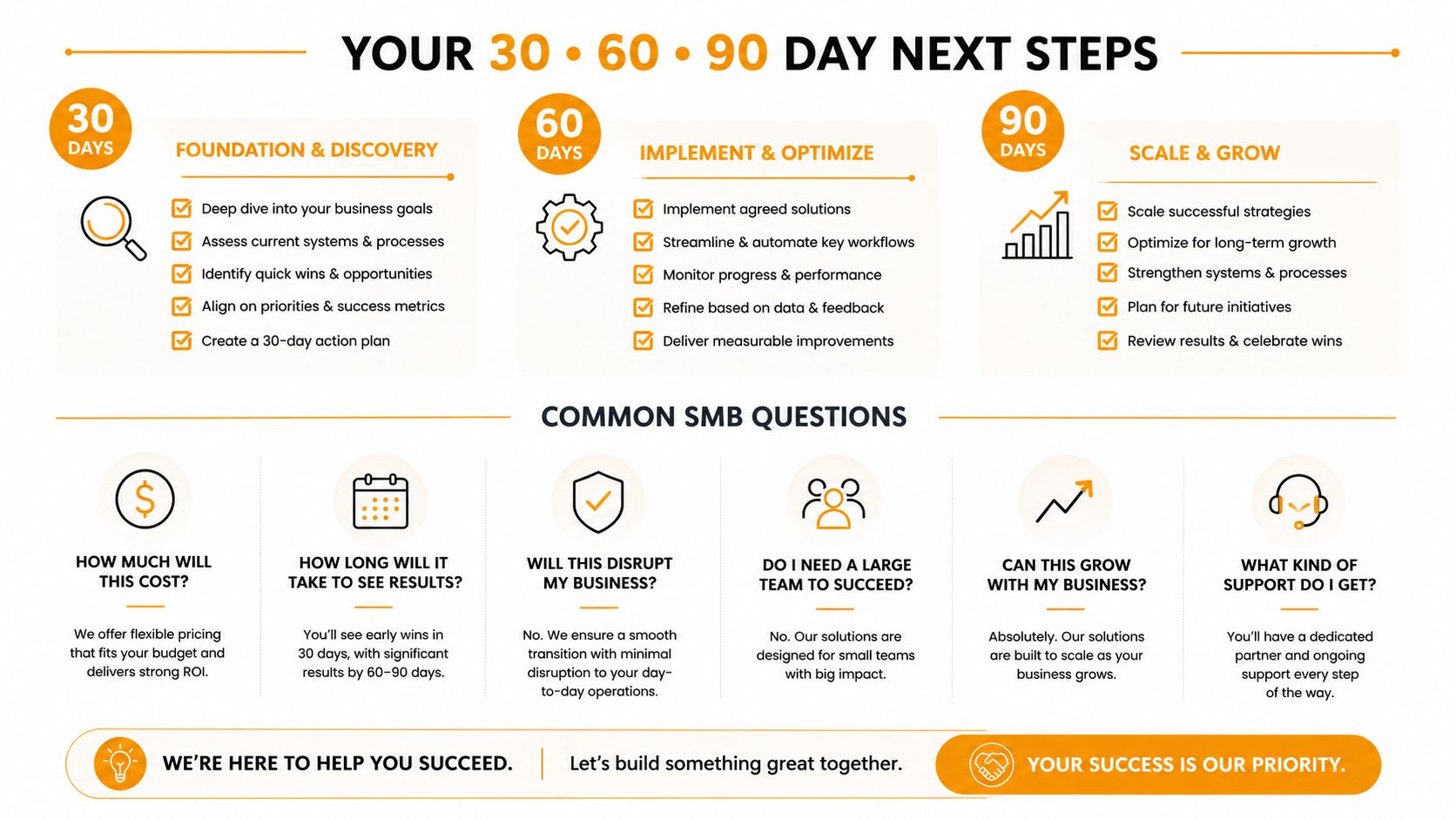
A practical roadmap keeps the assessment from becoming another unfinished project.
- First 30 days: Schedule discovery, build the asset inventory, and run an initial vulnerability scan.
- By 60 days: Complete interviews, review cloud and identity controls, and issue a draft findings report.
- By 90 days: Remediate high-priority issues, update policies, and schedule the first retest.
How often should an SMB reassess? Review risk when the business makes a major technology, staffing, vendor, or location change, and establish a recurring cycle for formal reassessment and ongoing control review.
Should vendors and SaaS be included? Yes. If a provider stores data, authenticates users, processes payments, or supports operations, its access belongs in scope.
What should you send an insurer or auditor? Provide the executive summary, scope, methodology, risk register, remediation evidence, policy records, backup test results, and retest documentation.
What does readiness mean with a tight budget? It means funding the controls that protect the most important systems first. The 2025 Devolutions State of IT Security report found that 29% of SMBs allocate less than 5% of IT spend to security, so prioritization matters more than buying every available tool.
IT Cloud Global, LLC can scope an IT security assessment for your Houston business, review Microsoft 365 and cloud controls, document prioritized risks, and connect findings to practical remediation. Visit IT Cloud Global, LLC to request a free estimate and discuss what your business needs to be ready before an incident.
- How to Prevent Data Breaches: A Practical Playbook for SMBs
- Remote Desktop IT Support Guide 2026
- Endpoint Protection vs Antivirus: A Houston Guide
- Houston IT Support: A 2026 Guide for SMBs
- What Is Network Access Control: Why Your Business Needs It
- Hybrid Cloud Management: A Practical Guide for SMBs
- Computer Service Near Me: A Houston Buyer’s Guide