


IT Project Consultants A Houston SMB Guide
You already know the feeling. A vendor says your cloud move will be simple. Your office expansion needs new Wi Fi, cabling, phones, and security. Your internal team is busy keeping people working, not running a complex rollout. Then the project starts slipping, the scope gets fuzzy, and nobody seems fully accountable.
That’s where it project consultants matter for Houston SMBs. Not as abstract strategy people. As the person or team that brings order, sequencing, documentation, vendor control, and business alignment to a project that can get expensive fast if it goes sideways.
Houston adds its own complexity. Many small and midsize businesses here run a mix of old and new systems. They may have one office, several sites, a warehouse, a clinic, a retail footprint, or field staff. They often need both local hands for on site work and outside expertise for cloud, security, and compliance. That hybrid reality is where good consultants help and bad ones create more friction.
Table of Contents
- What Exactly Is an IT Project Consultant
- When Your Business Needs an IT Project Consultant
- Key Services and Strategic Business Outcomes
- How to Choose the Right Consultant in Houston
- Understanding Engagement Models and Pricing
- Red Flags That Signal a Bad Partnership
- Your Partner for Predictable IT Outcomes
What Exactly Is an IT Project Consultant
An IT project consultant is the general contractor for your technology project.
Your managed service provider keeps day to day IT stable. They handle support tickets, patching, monitoring, device issues, and user support. A project consultant steps in when there’s a defined job with a beginning, middle, and end. Think office buildout, Microsoft 365 migration, Azure rollout, firewall replacement, VoIP deployment, or a cybersecurity remediation plan.

The distinction matters. If you’re comparing project consulting to ongoing support, this breakdown of the difference between IT services and managed services gives a useful baseline. One keeps the lights on. The other gets a major change delivered without disrupting the business more than necessary.
What they actually do
A solid consultant starts with business goals, not gear. If you’re opening a second office, they don’t begin with switch models. They begin with coverage needs, user count, failover expectations, security requirements, vendor dependencies, and the date you need people productive in the new space.
Then they coordinate the moving parts:
- Scope the project clearly so everyone knows what is in and out.
- Sequence the work so low voltage cabling, internet handoff, firewall setup, wireless, user devices, and testing happen in the right order.
- Manage vendors so your ISP, software providers, telecom partner, and internal stakeholders aren’t all working from different assumptions.
- Control risk by documenting rollback plans, change windows, approvals, and dependencies.
Practical rule: If nobody owns the dependencies between vendors, your business owns the delays.
Why this role keeps growing
This isn’t a niche function anymore. The global IT consulting industry statistics show $759.12 billion in revenue in 2023, with a projection of $1.5 trillion by 2030. That growth tracks with what business owners already see on the ground. More systems. More cloud. More security pressure. More integration work.
That doesn’t mean every project needs a large consulting firm. It does mean the role itself has become central. Even a smaller company may need outside project leadership for one critical migration or build.
If you want a simple example of how a structured advisory engagement is framed, Constructive-IT's expert consultation is a useful reference point. The value isn’t magic. It’s clarity, sequencing, and an informed outside view before expensive decisions get locked in.
When Your Business Needs an IT Project Consultant
Most Houston SMBs don’t wake up and decide they need a consultant. They hit a moment where normal IT support isn’t enough.

You’re moving offices. Expanding into another suite. Replacing old servers. Rolling out Microsoft 365. Preparing for a compliance review. Consolidating vendors. Cleaning up after a ransomware scare. Those are project moments, not ticketing moments.
The urgency is real. Project management statistics from Plaky note that only 50% of projects were successful in 2025. For a small business, that failure doesn’t show up as an abstract metric. It shows up as downtime, duplicate work, surprise invoices, and staff losing trust in the change.
Common triggers in Houston SMBs
Some need signs are obvious. Others sneak up on you.
- Office move or expansion: You need cabling, wireless design, internet coordination, security devices, printer planning, and user cutover with minimal downtime.
- Cloud migration: Your file server is aging out, remote work is clunky, or your backup strategy no longer fits the business.
- Compliance pressure: Healthcare, legal, financial, and operational businesses often need documentation, access control, and security changes that routine support doesn’t fully cover.
- Skill gap on the internal team: Your team may be strong at support but not at tenant migrations, firewall redesigns, or vendor-led implementations.
- Multiple vendors with no quarterback: The software company blames the network team. The network team blames the ISP. Nobody owns the whole outcome.
A business in that position often needs project leadership first, tools second.
Here’s a useful outside view on service coverage if you’re sorting out what should stay internal and what should be outsourced. ARPHost LLC's IT services outline the broader outsourcing side of the picture, which helps when deciding where project consulting fits.
The point where waiting costs more
A lot of owners wait because they don’t want “another vendor.” That hesitation is understandable. But delay usually means the project starts with weak scope, weak accountability, and rushed decisions.
This short video is a good primer on the role project oversight plays when technology changes affect the whole business.
Bring in a consultant before contracts are signed and hardware is ordered. That’s when they can still prevent bad decisions instead of documenting them.
Key Services and Strategic Business Outcomes
The best consultants don’t sell “help.” They solve a business problem with a technical plan.
When owners evaluate it project consultants, they should connect each service to an operational outcome. If the consultant can’t explain that connection in plain English, the engagement is too fuzzy.
Cloud migration and business continuity
A cloud migration isn’t just a move from one platform to another. It’s a redesign of access, backup, identity, security, and support.
If you’re moving from on prem file storage to Microsoft 365 or shifting workloads into Azure or AWS, the consultant should define user impact, permission mapping, backup coverage, rollback options, and post migration support. The payoff is business continuity and cleaner scaling, not just a new login screen.
According to PM Alliance’s guide to project management consulting for technology and innovation projects, project management consultants can deliver up to 20-30% improvements in project ROI, and optimized change management can reduce disruption by 25-35% during a Microsoft 365 migration. That matters because lost productivity during rollout often costs more than the software itself.
Security projects that reduce operational risk
Security work gets framed too narrowly. A consultant shouldn’t just install endpoint software and call it done. They should look at user roles, device control, phishing exposure, backup integrity, response paths, and documentation.
For Houston SMBs, this often includes:
- Endpoint protection tied to policy and response workflows
- Network segmentation for offices, guest wireless, and sensitive systems
- Microsoft 365 hardening across Exchange, Teams, SharePoint, and Intune
- Disaster recovery planning that matches actual recovery priorities
One practical option in this space is IT Cloud Global, LLC, which combines managed support with cloud, Microsoft 365, backup, network, and security services for Houston businesses. That kind of combined capability can help when a project needs both implementation and long term operational support.
A good consultant doesn’t just reduce technical risk. They reduce management risk by making ownership visible.
Infrastructure and communications projects
Some of the highest friction projects are still physical. New office networks, Wi Fi redesigns, low voltage cabling, VoIP cutovers, virtualization refreshes, and branch connectivity. These fail when the plan ignores how people work.
A consultant should ask where dead zones exist, what applications are latency sensitive, how phones are used, what after hours cutover window is realistic, and who approves each step. If they skip those questions, the design is probably too generic.
If you’re trying to tie the project back to business priorities before choosing tools, this framework to align IT with business goals is a useful reference.
How to Choose the Right Consultant in Houston
Houston SMBs don’t need the biggest consulting brand. They need the right fit for the project, the environment, and the way the business runs.
That usually means finding a consultant who can work across local realities. Older office buildings. Mixed infrastructure. Multi site needs. Compliance expectations. Staff who need local support on site, not just remote meetings and slide decks.
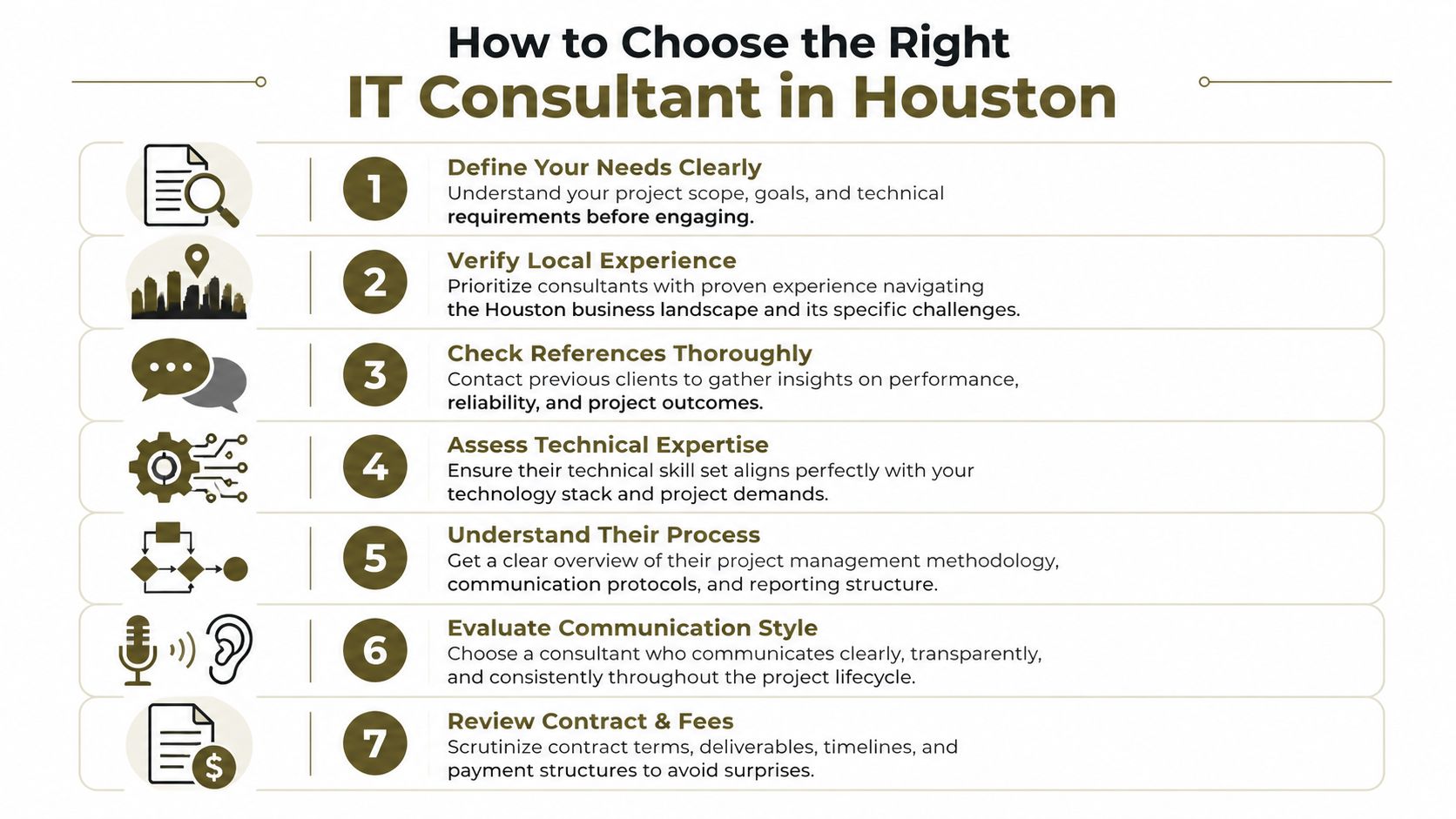
The local piece isn’t optional. A Hyland analysis on project failure and business alignment states that SMBs face 25-40% higher failure rates in cloud projects without localized expertise. That tracks with what many owners already experience. A remote consultant may understand cloud architecture but miss building access realities, regional expectations, or how on prem systems tie into daily operations.
The seven checks that matter
Use this list before you sign anything.
Define the project in business terms first
Write down the outcome you need. “Move us to the cloud” is weak. “Migrate files, email, identity, and backup with minimal user disruption before lease renewal” is much better.Ask about projects that look like yours
Not “Do you do cloud?” Ask, “Have you migrated a company our size from on prem systems to Azure while keeping line of business apps working?”Check local operating ability
Can they handle on site walkthroughs, cutovers, vendor meetings, and physical troubleshooting in Houston when needed?Test how they communicate
Ask for sample status reporting. If the answer is vague, expect vague project visibility later.Look at the handoff plan
Who owns support after go live? Your internal team, an MSP, or the consultant? Many projects fail in the gap after implementation.Review assumptions line by line
The proposal should state who supplies hardware, who coordinates the ISP, who handles user training, and what counts as a change request.Talk to references who had friction
Every consultant can find a happy reference. Ask for one where the scope changed or a vendor caused delays. That tells you how they operate under pressure.
Questions worth asking in the interview
Some questions reveal more than a credentials list:
- How do you manage scope when the owner wants speed but the team needs testing?
- What does your escalation path look like if a vendor misses a deadline?
- How do you handle projects that mix cloud changes with on site network work?
- What documentation do we receive at the end?
- Who on our team needs to be involved weekly?
For a practical companion checklist focused on provider selection, this guide on choosing an IT support provider in Houston is worth reviewing.
Local experience isn’t only about geography. It’s about knowing how to work inside the constraints your business actually has.
What good answers sound like
Good consultants answer in specifics. They talk about cutover windows, discovery, dependencies, acceptance criteria, rollback plans, and documentation. Weak consultants stay at the slogan level. They say they “streamline transformation” and “enable innovation,” but they don’t tell you who will do what by when.
That difference shows up early. Usually in the first call.
Understanding Engagement Models and Pricing
Most SMBs don’t struggle with the idea of hiring a consultant. They struggle with how the engagement is structured.
That’s a fair concern. The pricing model affects flexibility, budget control, and how much change the project can absorb without turning into a dispute.
IT Consultant Engagement Models Compared
| Model | Best For | Pros | Cons for SMBs |
|---|---|---|---|
| Project based fixed fee | Well defined projects such as office network buildouts, tenant migrations, or hardware refreshes with clear deliverables | Predictable cost, easier approval, clearer finish line | Less flexible if your scope changes or hidden issues appear |
| Time and materials | Evolving projects such as legacy cleanup, phased security remediation, or a migration with unknown dependencies | Flexible, useful when discovery will shape the work | Budget can drift if there’s weak oversight |
| Retainer | Ongoing strategic guidance, vendor oversight, roadmap planning, or fractional IT leadership | Access to expertise as needed, better continuity across multiple initiatives | Can feel expensive if you only use it occasionally |
How to match the model to the job
A fixed fee works best when the scope is stable. New office Wi Fi, cabling, firewall installation, and user cutover often fit this model if the site conditions are already known.
Time and materials makes more sense when you know the objective but not all the obstacles. That’s common in older Houston businesses with undocumented servers, aging switches, scattered file shares, or software no one has fully mapped.
A retainer fits companies that need consistent strategic oversight but don’t need a full time IT leader. It can work well when you have an internal admin or MSP but want a separate project and planning voice.
What owners should pin down before signing
Whatever model you choose, make sure the agreement answers these questions:
- What is included in discovery
- What triggers a scope change
- How status is reported
- Who approves added work
- What documentation is delivered at closeout
- Who supports the environment after go live
If you’re comparing project work to recurring support costs, this article on factors determining managed IT support service costs helps frame the difference.
The cheapest structure isn’t always the lowest cost. Poorly bounded hourly work can sprawl. Rigid fixed fee contracts can create conflict when reality changes. The right model is the one that matches how certain, or uncertain, your project really is.
Red Flags That Signal a Bad Partnership
A bad consulting relationship rarely fails all at once. It usually drifts off course in small, visible ways that the client ignores because they don’t want to disrupt the project.
That’s the mistake.

Pepper Foster’s consulting failure analysis notes that misaligned expectations cause 40% of consulting failures. It also states that consultants may do very well in planning, with 90% success, but struggle more in execution, at 60%, and that skilled internal staff often catch issues 50% earlier than pure external teams. That last point matters. Your team should not go passive after kickoff.
Early warning signs
Watch for patterns, not isolated bad days.
Status updates get softer over time
Clear milestones turn into vague phrases like “making progress” or “working through some issues.”Deadlines slip without a dependency explanation
Good consultants can tell you what blocked the task, who owns the unblock, and what moved because of it.Documentation is thin or delayed
If network diagrams, change logs, cutover plans, or admin credentials are poorly managed, the project is already harder to support.Every change becomes a billing event
Scope control matters, but constant nickel and diming often signals weak discovery or an intentionally low initial estimate.They isolate your internal team
That’s a major warning sign. Your staff should be in weekly reviews, decisions, and acceptance testing.
Watch for this: If the consultant treats your team as a barrier instead of part of the delivery model, execution risk is rising.
How to course correct before failure
You don’t need a dramatic confrontation. You need operating discipline.
Start with a weekly critical path review. Ask which tasks are late, which dependencies are open, what changed, and what decisions are waiting on your side. Require written updates.
Then tighten ownership:
- Name one client lead who can approve decisions quickly
- Require current documentation before each major milestone
- Log risks openly rather than discussing them only in calls
- Confirm handoff criteria before go live, not after
If the consultant resists that level of transparency, the issue isn’t style. It’s control.
What good partnership behavior looks like
A good consultant escalates early. They tell you when your own team is overloaded. They document assumptions. They admit when a vendor is the blocker. They don’t hide complexity to keep the relationship comfortable.
The test is simple. When something goes wrong, do you get clarity or spin?
Your Partner for Predictable IT Outcomes
For most SMBs, the primary value of it project consultants isn’t technical brilliance by itself. It’s predictability.
You want to know what’s being changed, why it’s being changed, what could go wrong, who owns each task, how users will be affected, and what support looks like afterward. That’s what turns a stressful technology initiative into a manageable business project.
Houston businesses have an added decision to make. They often need both local execution and broader technical depth. That’s why the strongest setups usually combine practical on site awareness with structured project management and a clear long term support plan.
If you’re evaluating a consultant now, keep it simple. Define the business outcome. Vet local fit. Choose the pricing model that matches the scope. Stay involved after kickoff. And don’t ignore early warning signs just because the project is already underway.
A well chosen consultant is not overhead when the alternative is rework, downtime, and a botched rollout. It’s a way to make complex change more controlled.
If you’re planning a migration, office expansion, security project, or infrastructure refresh in Houston, IT Cloud Global, LLC is one practical place to start. A short discovery conversation can help clarify scope, identify risks, and determine whether you need project consulting, managed services, or a mix of both before the work begins.
- Top IT Services Houston TX: Your 2026 SMB Guide
- Houston Managed IT Services: A 2026 Guide for SMBs
- How Long Does Data Recovery Take? Realistic Timelines
- What Is a Helpdesk Ticketing System? an SMB Guide
- Your 2026 Disaster Recovery Testing Checklist
- What Is Virtualization in Computing? Save & Boost Uptime
- Cloud Computing Solutions for Small Business: Houston 2026